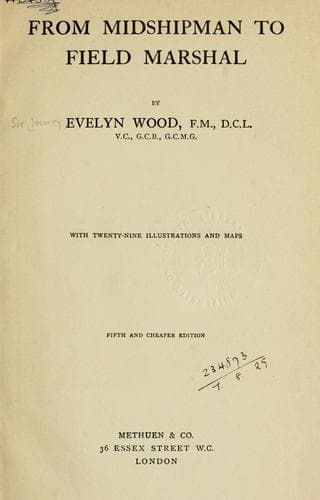
Great Britain -- History, Military -- 19th century; Marshals -- Great Britain -- Biography; Wood, Evelyn, 1838-1919
When I saw my Chief in camp that evening, I found with him one of our
senior officers, and from what I heard when entering his tent, gathered
that he was arranging for an assault. He turned to me and said, “Oh,
Wood, you are not well to-day.” I replied, “Not well, sir, but not
very ill.” “You had better go to bed; I shall not want you to-morrow
morning.” “I suppose, sir, that we are going to assault?” “Yes, and
as you are not well enough to go up with us, you will please stop in
camp.” “Are you going to take your other Aide-de-Camp, sir?” “Yes; I
promised him a long time ago.”
I left the tent no doubt showing the disappointment I felt, so Captain
Peel called me back and said, “Well, well, you may go on with me as far
as the battery, but no farther.” To which I immediately replied, “Is
the other Aide-de-Camp to go on with you?” And he said, “Yes, I intend
to take him to the Redan.”
That evening in our camp I had to submit to a good deal of chaff, for
it was known immediately that Captain Peel did not intend to take me
out with him. On entering one of the Messes of which I was an honorary
member, the conversation turned on the impending Assault, and one of
the officers laughed at me, but in a friendly way, for having been
forbidden to go beyond the battery. I said, “Barring accidents, I’ll
bet you I go as far as my Chief.” Another officer observed, “I’ll
lay five sovereigns to one, young Wood is killed to-morrow.” Dalyell
replied, “Done; but bet’s off if I am killed.”
My friend was more irritated by the remark than I was; but the man
had however, no intention of being unkind, for nine months’ constant
warfare with the daily losses in the trenches had no doubt blunted our
senses. The question of Life and Death was discussed at meals with
the utmost freedom, and there were indeed some grounds for supposing
that the immunity I had hitherto enjoyed could not continue. Fifty
Naval officers landed on the 2nd October, and there were only two of
us present who had been on duty throughout the winter. Some of our
comrades had been killed, more wounded, and the remainder invalided
home, or sent to England for various reasons, the more common being
that of their promotion.
At ten o’clock that night, having instructed a Bluejacket standing
sentry near my tent to rouse me when the Ladder parties paraded, I fell
asleep. The sentry, however, did not awake me, having been cautioned
personally by Captain Peel that I was not to be aroused. The men
“falling in” awoke me at midnight however, and my brother Aide-de-Camp
coming to see if I was awake, we agreed that if, as was probable, our
Chief was killed in the assault, one of us should stand by him, or
bring in his body.
Public-domain text, read in full here on John Shaqi.
Reviews
Reviews
No reviews yet
Be the first to share your thoughts on this work.
Elsewhere in the archive
Join the Discussion
Join the discussion
Sign in to leave a comment or review.
Sign InorCreate an account