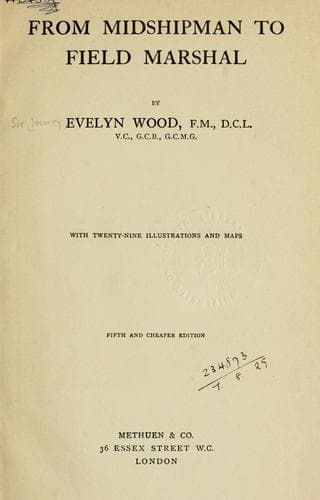
Great Britain -- History, Military -- 19th century; Marshals -- Great Britain -- Biography; Wood, Evelyn, 1838-1919
I have always been a nervous patient under a surgeon, and personally
removed eight pieces of bone. My difficulty was to see the wound, as
being outside, I could not turn the arm round sufficiently. I had a
firm cushion made, on which I rested the arm, opposite a mirror, and
then by working with care and patience I got out eight pieces, the
first 1¼ inches long, in September. They were all edged with points
like needles, but it was the first only which seriously hurt me. The
last bit I let our Doctor remove, at Scutari, in February 1856, for it
was small, and came away easily on his opening an abscess, which had
formed over the wound.
In the middle of the month I spent a short but most enjoyable visit
with Captain Peel at Sandy. The morning after I arrived a deputation
from Potton asked my host to link their village by tramway with the
Great Northern Station at Sandy, a distance of about three miles.
Having inquired the terms, he sat down and made his calculations,
while they waited, and in less than an hour he dismissed them with a
favourable answer. He constructed the tramway, which was taken over by
the Bedford & Cambridge Railway Company, when that line was made, five
years later.
Captain Peel was as good at playing host as he was at fighting, and
I left the place with an increased admiration of my late Chief’s
character. Three months later he came to see me at Dorchester, being
anxious that I should study my new profession, and not content myself
with sauntering through life in the Army.
When I joined the Depot at Dorchester there were but two Duty officers,
both recently appointed. There was no Mess, and one of the Cornets,
the son of a Riding Master, having no private income, lived entirely
in his room. The other, Reynold Clements, a University graduate, and I
dined at the King’s Arms Hotel, where we were soon joined by Stanley
Clarke, now General Sir S. de A. Clarke, G.C.V.O., Aide-de-Camp to the
King, who was recovering from recent illness. Before the end of the
month more Cornets joined, and a Mess was formed in Barracks. This
added materially to my daily expenses, for although I was a water
drinker, all wine was shared by dining members. The Riding Master was
in command, and being married did not dine at Mess. There was only one
senior Lieutenant, who exercised no control, and champagne was drunk
daily.
My father could only find ready money sufficient to pay for my
chargers, £220; so my mother sent me to Messrs. W. E. Seagrove, the
Portsea Naval Outfitters, who having supplied my kit in 1852, were
willing to allow credit. They gave excellent value for the money, but
had some difficulty in the unaccustomed job of fitting overalls.[48]
The fit of the riding trousers was then important for an officer’s
reputation. That the foot of the trousers should always rest on the
spur when the knee was bent, was essential for the enjoyment of a
peaceful life in Mess, and the avoiding of sarcastic remarks by the
senior officers on parade.
Public-domain text, read in full here on John Shaqi.
Reviews
Reviews
No reviews yet
Be the first to share your thoughts on this work.
Elsewhere in the archive
Join the Discussion
Join the discussion
Sign in to leave a comment or review.
Sign InorCreate an account