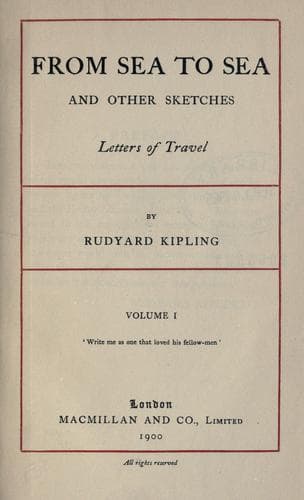
From Sea to Sea; Letters of TravelKipling, Rudyard
General
From Sea to Sea; Letters of Travel
Kipling, Rudyard
Asia -- Description and travel; Kipling, Rudyard, 1865-1936 -- Travel; United States -- Description and travel; Voyages and travels
From the Rutton Daulat the warden unlocked doors that led into a hall of
audience--the Chutter Mahal--built by Raja Chutter Lal, who was killed
more than two hundred years ago in the latter days of Shah Jehan for
whom he fought. Two rooms, each supported on double rows of pillars,
flank the open space, in the centre of which is a marble reservoir. Here
the Englishman looked anxiously for some of the atrocities of the West,
and was pleased to find that, with the exception of a vase of
artificial flowers and a clock, there was nothing that jarred with the
exquisite pillars, and the raw blaze of colour in the roofs of the
rooms. In the middle of these impertinent observations, something
sighed--sighed like a distressed ghost. Unaccountable voices are at all
times unpleasant, especially when the hearer is some hundred feet or so
above ground in an unknown Palace in an unknown land. A gust of wind had
found its way through one of the latticed balconies, and had breathed
upon a thin plate of metal, some astrological instrument, slung gongwise
on a tripod. The tone was as soft as that of an Æolian harp, and,
because of the surroundings, infinitely more plaintive.
There was an inlaid ivory door, set in lintel and posts crusted with
looking-glass--all apparently old work. This opened into a darkened room
where there were gilt and silver charpoys, and portraits, in the native
fashion, of the illustrious dead of Boondi. Beyond the darkness was a
balcony clinging to the sheer side of the Palace, and it was then that
the Englishman realised to what a height he had climbed without knowing
it. He looked down upon the bustle of the Treasury and the stream of
life flowing into and out of the Gate of the Fishes where the big drums
lie. Lifting his eyes, he saw how Boondi City had built itself,
spreading from west to east as the confined valley became too narrow and
the years more peaceable. The Boondi hills are the barrier that
separates the stony, uneven ground near Deoli from the flats of Kotah,
twenty miles away. From the Palace balcony the road to the eye is clear
to the banks of the Chumbul River, which was the Debatable Ford in times
gone by and was leaped, as all rivers with any pretensions to a
pedigree have been, by more than one magic horse. Northward and easterly
the hills run out to Indurgarh, and southward and westerly to territory
marked "disputed" on the map in the present year of grace. From this
balcony the Raja can see to the limit of his territory eastward, his
empire all under his hand. He is, or the Politicals err, that same Ram
Singh who was installed by Tod in 1821, and for whose success in killing
his first deer, Tod was, by the Queen-Mother of Boondi, bidden to
rejoice. To-day the people of Boondi say: "This Durbar is very old; so
old that few men remember its beginning, for that was in our father's
time." It is related also of Boondi that, on the occasion of the Queen's
Public-domain text, read in full here on John Shaqi.
Reviews
Reviews
No reviews yet
Be the first to share your thoughts on this work.
Elsewhere in the archive
Join the Discussion
Join the discussion
Sign in to leave a comment or review.
Sign InorCreate an account