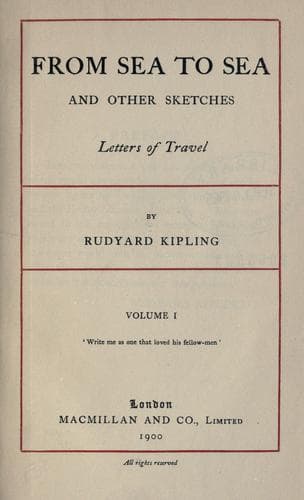
From Sea to Sea; Letters of TravelKipling, Rudyard
General
From Sea to Sea; Letters of Travel
Kipling, Rudyard
Asia -- Description and travel; Kipling, Rudyard, 1865-1936 -- Travel; United States -- Description and travel; Voyages and travels
conceal his feelings very well; for he speaks most fluently in praise of
his own regiment; and, for all his youth, has a keen appreciation of the
merits of his officers. Go to him when his heart is opened, and hear him
going through the roll of the subalterns, by a grading totally unknown
in the Army List, and you will pick up something worth the hearing.
Thomas, with the Burma fever on him, tried to cut in, from time to time,
with stories of his officers and what they had done "when we was
marchin' all up and down Burma," but the little Corporal went on gayly.
They made a curious contrast--these two types. The lathy, town-bred
Thomas with hock-bottle shoulders, a little education, and a keen desire
to get more medals and stripes; and the little, deep-chested,
bull-necked Corporal brimming over with vitality and devoid of any ideas
beyond the "regiment." And the end of both lives, in all likelihood,
would be a nameless grave in some cantonment burying-ground with, if the
case were specially interesting and the Regimental Doctor had a turn for
the pen, an obituary notice in the Indian Medical Journal. It was an
unpleasant thought.
From the Army to the Navy is a perfectly natural transition, but one
hardly to be expected in the heart of India. Dawn showed the railway
carriage full of riotous boys, for the Agra and Mount Abu schools had
broken up for holidays. Surely it was natural enough to ask a
child--not a boy, but a child--whether he was going home for the
holidays; and surely it was a crushing, a petrifying thing to hear in a
clear treble tinged with icy scorn: "No. I'm on leave. I'm a
midshipman." Two "officers of Her Majesty's Navy"--mids of a man-o'-war
at Bombay--were going up-country on ten days' leave. They had not
travelled much more than twice round the world; but they should have
printed the fact on a label. They chattered like daws, and their talk
was as a whiff of fresh air from the open sea, while the train ran
eastward under the Aravalis. At that hour their lives were bound up in
and made glorious by the hope of riding a horse when they reached their
journey's end. Much had they seen "cities and men," and the artless way
in which they interlarded their conversation with allusions to "one of
those shore-going chaps, you see," was delicious. They had no cares, no
fears, no servants, and an unlimited stock of wonder and admiration for
everything they saw, from the "cute little well-scoops" to a herd of
deer grazing on the horizon. It was not until they had opened their
young hearts with infantile abandon that the listener could guess from
the incidental _argot_ where these pocket-Ulysseses had travelled. South
African, Norwegian, and Arabian words were used to help out the slang of
shipboard, and a copious vocabulary of shipboard terms, complicated with
modern Greek. As free from self-consciousness as children, as ignorant
as beings from another planet of the Anglo-Indian life into which they
Public-domain text, read in full here on John Shaqi.
Reviews
Reviews
No reviews yet
Be the first to share your thoughts on this work.
Elsewhere in the archive
Join the Discussion
Join the discussion
Sign in to leave a comment or review.
Sign InorCreate an account