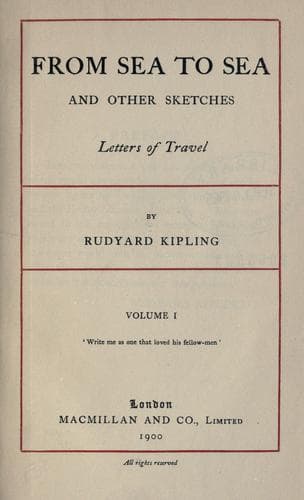
From Sea to Sea; Letters of TravelKipling, Rudyard
General
From Sea to Sea; Letters of Travel
Kipling, Rudyard
Asia -- Description and travel; Kipling, Rudyard, 1865-1936 -- Travel; United States -- Description and travel; Voyages and travels
The trunks disappeared, the door shut, the heels clicked down the
passage, and I was left scratching my head in wonder. How did that
conversation begin--why did it end, and what is the use of meeting
eccentricities who never explained themselves? I shall never get an
answer, but that conversation is true, every word of it. I see now where
the fragmentary school of novelists get their material from.
When I went into the streets of Hong-Kong I stepped into thick slushy
London mud of the kind that strikes chilly through the boot, and the
rattle of innumerable wheels was as the rattle of hansoms. A soaking
rain fell, and all the sahibs hailed 'rickshaws,--they call them 'ricks
here,--and the wind was chillier than the rain. It was the first touch
of honest weather since Calcutta. No wonder with such a climate that
Hong-Kong was ten times livelier than Singapur, that there were signs of
building everywhere, and gas-jets in all the houses, that colonnades and
domes were scattered broadcast, and the Englishmen walked as Englishmen
should--hurriedly and looking forward. All the length of the main street
was verandahed, and the Europe shops squandered plate glass by the
square yard. (_Nota bene._--As in Simla so elsewhere: mistrust the plate
glass shops. You pay for their fittings in each purchase.)
The same Providence that runs big rivers so near to large cities puts
main thoroughfares close to big hotels. I went down Queen Street, which
is not very hilly. All the other streets that I looked up were built in
steps after the fashion of Clovelly, and under blue skies would have
given the Professor scores of good photographs. The rain and the fog
blotted the views. Each upward-climbing street ran out in white mist
that covered the sides of a hill, and the downward-sloping ones were
lost in the steam from the waters of the harbour, and both were very
strange to see. "Hi-yi-yow," said my 'rickshaw coolie and balanced me
on one wheel. I got out and met first a German with a beard, then three
jolly sailor boys from a man-of-war, then a sergeant of Sappers, then a
Parsee, then two Arabs, then an American, then a Jew, then a few
thousand Chinese all carrying something, and then the Professor.
"They make plates--instantaneous plates--in Tokio, I'm told. What d'you
think of that?" he said. "Why, in India, the Survey Department are the
only people who make their own plates. Instantaneous plates in Tokio;
think of it!"
I had owed the Professor one for a long time. "After all," I replied,
"it strikes me that we have made the mistake of thinking too much of
India. We thought we were civilised, for instance. Let us take a lower
place. This beats Calcutta into a hamlet."
Public-domain text, read in full here on John Shaqi.
Reviews
Reviews
No reviews yet
Be the first to share your thoughts on this work.
Elsewhere in the archive
Join the Discussion
Join the discussion
Sign in to leave a comment or review.
Sign InorCreate an account