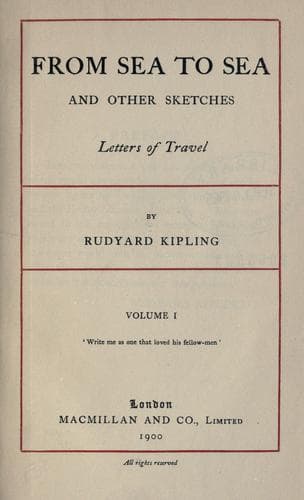
From Sea to Sea; Letters of TravelKipling, Rudyard
General
From Sea to Sea; Letters of Travel
Kipling, Rudyard
Asia -- Description and travel; Kipling, Rudyard, 1865-1936 -- Travel; United States -- Description and travel; Voyages and travels
"They are a hundred times his superior in mere idea--let alone
execution," said the Professor, his hand on a sketch in woods and gems
of a woman caught in a gale of wind protecting her baby from its
violence.
"Yes; and don't you see that _they_ only introduce aniline dyes into
things intended for _us_. Whereas _he_ wears them on his body whenever
he can. What made this yellow image of a shopman here take delight in a
dwarf orange tree in a turquoise blue pot?" I continued, sorting a
bundle of cheap China spoons--all good in form, colour, and use. The
big-bellied Chinese lanterns above us swayed in the wind with a soft
chafing of oiled paper, but they made no sign, and the shopkeeper in
blue was equally useless.
"You wanchee buy? Heap plitty things here," said he; and he filled a
tobacco-pipe from a dull green leather pouch held at the mouth with a
little bracelet of plasma, or it might have been the very jade. He was
playing with a brown-wood abacus, and by his side was his day-book bound
in oiled paper, and the tray of Indian ink, with the brushes and the
porcelain supports for the brushes. He made an entry in his book and
daintily painted in his latest transaction. The Chinese of course have
been doing this for a few thousand years, but Life, and its experiences,
is as new to me as it was to Adam, and I marvelled.
"Wanchee buy?" reiterated the shopman after he had made his last
flourish.
"You," said I, in the new tongue which I am acquiring, "wanchee know one
piecee information b'long my pidgin. Savvy these things? Have got soul,
you?"
"Have got how?"
"Have got one piecee soul--allee same spilit? No savvy? This way
then--your people lookee allee same devil; but makee culio allee same
pocket-Joss, and not giving any explanation. Why-for are you such a
horrible contradiction?"
"No savvy. Two dollar an' half," he said, balancing a cabinet in his
hand. The Professor had not heard. His mind was oppressed with the fate
of the Hindu.
"There are three races who can work," said the Professor, looking down
the seething street where the 'rickshaws tore up the slush, and the
babel of Cantonese, and pidgin went up to the yellow fog in a jumbled
snarl.
"But there is only one that can swarm," I answered. "The Hindu cuts his
own throat and dies, and there are too few of the Sahib-log to last for
ever. These people work and spread. They must have souls or they
couldn't understand pretty things."
"I can't make it out," said the Professor. "They are better artists than
the Hindu,--that carving you are looking at is Japanese, by the
way,--better artists and stronger workmen, man for man. They pack close
and eat everything, and they can live on nothing."
"And I've been praising the beauties of Indian Art all my days." It was
a little disappointing when you come to think of it, but I tried to
console myself by the thought that the two lay so far apart there was no
comparison possible. And yet accuracy is surely the touchstone of all
Art.
Public-domain text, read in full here on John Shaqi.
Reviews
Reviews
No reviews yet
Be the first to share your thoughts on this work.
Elsewhere in the archive
Join the Discussion
Join the discussion
Sign in to leave a comment or review.
Sign InorCreate an account