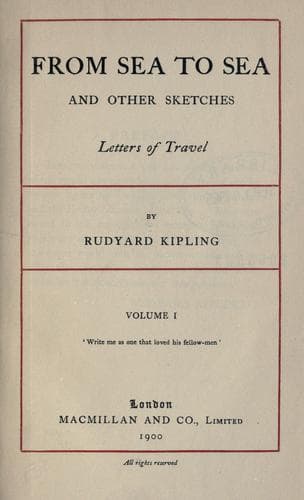
From Sea to Sea; Letters of TravelKipling, Rudyard
General
From Sea to Sea; Letters of Travel
Kipling, Rudyard
Asia -- Description and travel; Kipling, Rudyard, 1865-1936 -- Travel; United States -- Description and travel; Voyages and travels
Then we ran through a succession of second-rate streets and houses till
we reached the city wall on the west by a long flight of steps. It was
clean here. The wall had a drop of thirty or forty feet to paddy fields.
Beyond these were a semicircle of hills, every square yard of which is
planted out with graves. Her dead watch Canton the abominable, and the
dead are more than the myriads living. On the grass-grown top of the
wall were rusty English guns spiked and abandoned after the war. They
ought not to be there. A five-storied pagoda gave us a view of the city,
but I was wearied of these rats in their pit--wearied and scared and
sullen. The excellent Ah Cum led us to the Viceroy's summer garden-house
on the cityward slope of an azalea-covered hill surrounded by cotton
trees. The basement, was a handsome joss house: upstairs was a
durbar-hall with glazed verandahs and ebony furniture ranged across the
room in four straight lines. It was only an oasis of cleanliness. Ten
minutes later we were back in the swarming city, cut off from light and
sweet air. Once or twice we met a mandarin with thin official mustache
and "little red button a-top." Ah Cum was explaining the nature and
properties of a mandarin when we came to a canal spanned by an English
bridge and closed by an iron gate, which was in charge of a Hong-Kong
policeman. We were in an Indian station with Europe shops and Parsee
shops and everything else to match. This was English Canton, with two
hundred and fifty sahibs in it. 'Twould have been better for a Gatling
behind the bridge gate. The guide-books tell you that it was taken from
the Chinese by the treaty of 1860, the French getting a similar slice of
territory. Owing to the binding power of French officialism, "La
concession Française" has never been let or sold to private individuals,
and now a Chinese regiment squats on it. The men who travel tell you
somewhat similar tales about land in Saigon and Cambodia. Something
seems to attack a Frenchman as soon as he dons a colonial uniform. Let
us call it the red-tape-worm.
"Now where did you go and what did you see?" said the Professor, in the
style of the pedagogue, when we were once more on the _Ho-nam_ and
returning as fast as steam could carry us to Hong-Kong.
"A big blue sink of a city full of tunnels, all dark and inhabited by
yellow devils, a city that Doré ought to have seen. I'm devoutly
thankful that I'm never going back there. The Mongol will begin to march
in his own good time. I intend to wait until he marches up to me. Let us
go away to Japan by the next boat."
The Professor says that I have completely spoiled the foregoing account
by what he calls "intemperate libels on a hard-working nation." He did
not see Canton as I saw it--through the medium of a fevered imagination.
Public-domain text, read in full here on John Shaqi.
Reviews
Reviews
No reviews yet
Be the first to share your thoughts on this work.
Elsewhere in the archive
Join the Discussion
Join the discussion
Sign in to leave a comment or review.
Sign InorCreate an account