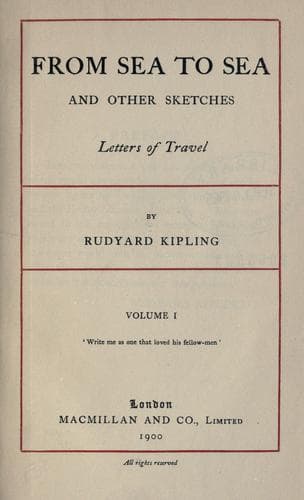
From Sea to Sea; Letters of TravelKipling, Rudyard
General
From Sea to Sea; Letters of Travel
Kipling, Rudyard
Asia -- Description and travel; Kipling, Rudyard, 1865-1936 -- Travel; United States -- Description and travel; Voyages and travels
[10] A sacred herb of the Hindus.
Let us not compare the two men, but go on through Nagasaki.
Except for the horrible policemen who insist on being Continental, the
people--the common people, that is--do not run after unseemly costumes
of the West. The young men wear round felt hats, occasionally coats and
trousers, and semi-occasionally boots. All these are vile. In the more
metropolitan towns men say Western dress is rather the rule than the
exception. If this be so, I am disposed to conclude that the sins of
their forefathers in making enterprising Jesuit missionaries into
beefsteak have been visited on the Japanese in the shape of a partial
obscuration of their artistic instincts. Yet the punishment seems rather
too heavy for the offence.
Then I fell admiring the bloom on the people's cheeks, the
three-cornered smiles of the fat babes, and the surpassing "otherness"
of everything round me. It is so strange to be in a clean land, and
stranger to walk among doll's houses. Japan is a soothing place for a
small man. Nobody comes to tower over him, and he looks down upon all
the women, as is right and proper. A dealer in curiosities bent himself
double on his own door-mat, and I passed in, feeling for the first time
that I was a barbarian, and no true Sahib. The slush of the streets was
thick on my boots, and he, the immaculate owner, asked me to walk across
a polished floor and white mats to an inner chamber. He brought me a
foot-mat, which only made matters worse, for a pretty girl giggled round
the corner as I toiled at it. Japanese shopkeepers ought not to be so
clean. I went into a boarded passage about two feet wide, found a gem of
a garden of dwarfed trees, in the space of half a tennis court, whacked
my head on a fragile lintel, and arrived at a four-walled daintiness
where I involuntarily lowered my voice. Do you recollect Mrs.
Molesworth's _Cuckoo Clock_, and the big cabinet that Griselda entered
with the cuckoo? I was not Griselda, but my low-voiced friend, in his
long, soft wraps, was the cuckoo, and the room was the cabinet. Again I
tried to console myself with the thought that I could kick the place to
pieces; but this only made me feel large and coarse and dirty,--a most
unfavourable mood for bargaining. The cuckoo-man caused pale tea to be
brought,--just such tea as you read of in books of travel,--and the tea
completed my embarrassment. What I wanted to say was, "Look here, you
person. You're much too clean and refined for this life here below, and
your house is unfit for a man to live in until he has been taught a lot
of things which I have never learned. Consequently I hate you because I
feel myself your inferior, and you despise me and my boots because you
know me for a savage. Let me go, or I'll pull your house of cedar-wood
over your ears." What I really said was, "Oh, ah yes. Awf'ly pretty.
Awful queer way of doing business."
Public-domain text, read in full here on John Shaqi.
Reviews
Reviews
No reviews yet
Be the first to share your thoughts on this work.
Elsewhere in the archive
Join the Discussion
Join the discussion
Sign in to leave a comment or review.
Sign InorCreate an account