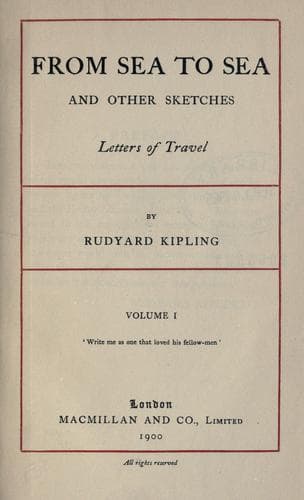
From Sea to Sea; Letters of TravelKipling, Rudyard
General
From Sea to Sea; Letters of Travel
Kipling, Rudyard
Asia -- Description and travel; Kipling, Rudyard, 1865-1936 -- Travel; United States -- Description and travel; Voyages and travels
I hate a man who is ashamed of his faith. There was a story connected
with those gods, and the priest would not tell it to me. So I sniffed at
him scornfully, and went my way. It led me from the temple straight into
the monastery, which was all made of delicate screens, polished floors,
and brown wood ceilings. Except for my tread on the boards there was no
sound in the place till I heard some one breathing heavily behind a
screen. The priest slid back what had appeared to me a dead wall, and we
found a very old priest half-asleep over his charcoal handwarmer. This
was the picture. The priest in olive-green, his bald head, pure silver,
bowed down before a sliding screen of white oiled paper which let in
dull silver light. To his right a battered black lacquer stand
containing the Indian ink and brushes with which he feigned to work. To
the right of these, again, a pale yellow bamboo table holding a vase of
olive-green crackle, and a sprig of almost black pine. There were no
blossoms in this place. The priest was too old. Behind the sombre
picture stood a gorgeous little Buddhist shrine,--gold and vermilion.
"He makes a fresh picture for the little screen here every day," said
the young priest, pointing first to his senior, and then to a blank
little tablet on the wall. The old man laughed pitifully, rubbed his
head, and handed me his picture for the day. It represented a flood
over rocky ground; two men in a boat were helping two others on a tree
half-submerged by the water. Even I could tell that the power had gone
from him. He must have drawn well in his manhood, for one figure in the
boat had action and purpose as it leaned over the gunwale; but the rest
was blurred, and the lines had wandered astray as the poor old hand had
quavered across the paper. I had no time to wish the artist a pleasant
old age, and an easy death in the great peace that surrounded him,
before the young man drew me away to the back of the shrine, and showed
me a second smaller altar facing shelves on shelves of little gold and
lacquer tablets covered with Japanese characters.
"These are memorial tablets of the dead," he giggled. "Once and again
the priest he prays here--for those who are dead, you understand?"
"Perfectly. They call 'em masses where I come from. I want to go away
and think about things. You shouldn't laugh, though, when you show off
your creed."
"Ha, ha!" said the young priest, and I ran away down the dark polished
passages with the faded screens on either hand, and got into the main
courtyard facing the street, while the Professor was trying to catch
temple fronts with his camera.
Public-domain text, read in full here on John Shaqi.
Reviews
Reviews
No reviews yet
Be the first to share your thoughts on this work.
Elsewhere in the archive
Join the Discussion
Join the discussion
Sign in to leave a comment or review.
Sign InorCreate an account