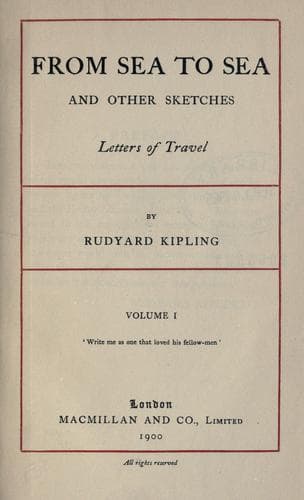
From Sea to Sea; Letters of TravelKipling, Rudyard
General
From Sea to Sea; Letters of Travel
Kipling, Rudyard
Asia -- Description and travel; Kipling, Rudyard, 1865-1936 -- Travel; United States -- Description and travel; Voyages and travels
Sorely against my will--for it was in my mind to fudge Japan from a
guide-book while I enjoyed the cookery of the Oriental at Kobé--I was
dragged into a 'rickshaw and the rain, and conveyed to a railway
station. Even the Japanese cannot make their railway stations lovely,
though they do their best. Their system of baggage-booking is borrowed
from the Americans; their narrow-gauge lines, locos, and rolling stock
are English; their passenger-traffic is regulated with the precision of
the Gaul, and the uniforms of their officials come from the nearest
ragbag. The passengers themselves were altogether delightful. A large
number of them were modified Europeans, and resembled nothing more than
Tenniel's picture of the White Rabbit on the first page of _Alice in
Wonderland_. They were dressed in neat little tweed suits with
fawn-coloured overcoats, and they carried ladies' reticules of black
leather and nickel platings. They wore paper and celluloid stuck-up
collars which must have been quite thirteen inches round the neck, and
their boots were number fours. On their hands--their wee-wee hands--they
had white cotton gloves, and they smoked cigarettes from fairy little
cigarette cases. That was young Japan--the Japan of the present day.
"Wah, wah, God is great," said the Professor. "But it isn't in human
nature for a man who sprawls about on soft mats by instinct to wear
Europe clothes as though they belonged to him. If you notice, the last
thing that they take to is shoes."
A lapis-lazuli coloured locomotive which, by accident, had a mixed train
attached to it happened to loaf up to the platform just then, and we
entered a first-class English compartment. There was no stupid double
roof, window shade, or abortive thermantidote. It was a London and
South-Western carriage. Osaka is about eighteen miles from Kobé, and
stands at the head of the bay of Osaka. The train is allowed to go as
fast as fifteen miles an hour and to play at the stations all along the
line. You must know that the line runs between the hills and the shore,
and the drainage-fall is a great deal steeper than anything we have
between Saharunpur and Umballa. The rivers and the hill torrents come
down straight from the hills on raised beds of their own formation,
which beds again have to be bunded and spanned with girder bridges
or--here, perhaps, I may be wrong--tunnelled.
The stations are black-tiled, red-walled, and concrete-floored, and all
the plant from signal levers to goods-truck is English. The official
colour of the bridges is a yellow-brown most like unto a faded
chrysanthemum. The uniform of the ticket-collectors is a peaked forage
cap with gold lines, black frock-coat with brass buttons, very long in
the skirt, trousers with black mohair braid, and buttoned kid boots. You
cannot be rude to a man in such raiment.
Public-domain text, read in full here on John Shaqi.
Reviews
Reviews
No reviews yet
Be the first to share your thoughts on this work.
Elsewhere in the archive
Join the Discussion
Join the discussion
Sign in to leave a comment or review.
Sign InorCreate an account