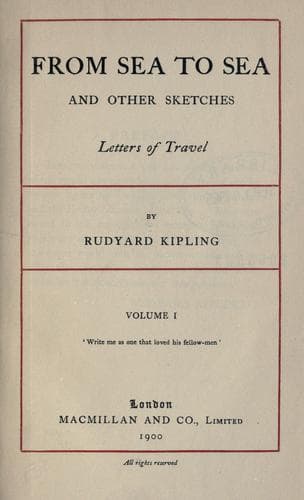
From Sea to Sea; Letters of TravelKipling, Rudyard
General
From Sea to Sea; Letters of Travel
Kipling, Rudyard
Asia -- Description and travel; Kipling, Rudyard, 1865-1936 -- Travel; United States -- Description and travel; Voyages and travels
The tea-house system of the Japanese filled me with pleasure at a
pleasure that I could not fully comprehend. It pays a company in Osaka
to build on the outskirts of the town a nine-storied pagoda of wood and
iron, to lay out elaborate gardens round it, and to hang the whole with
strings of blood-red lanterns, because the Japanese will come wherever
there is a good view to sit on a mat and discuss tea and sweetmeats and
_saki_. This Eiffel Tower is, to tell the truth, anything but pretty,
yet the surroundings redeem it. Although it was not quite completed,
the lower storeys were full of tea-stalls and tea-drinkers. The men and
women were obviously admiring the view. It is an astounding thing to see
an Oriental so engaged; it is as though he had stolen something from a
sahib.
From Osaka--canal-cut, muddy, and fascinating Osaka--the Professor,
Mister Yamagutchi,--the guide,--and I took train to Kioto, an hour from
Osaka. On the road I saw four buffaloes at as many rice-ploughs--which
was noticeable as well as wasteful. A buffalo at rest must cover the
half of a Japanese field; but perhaps they are kept on the mountain
ledges and only pulled down when wanted. The Professor says that what I
call buffalo is really bullock. The worst of travelling with an accurate
man is his accuracy. We argued about the Japanese in the train, about
his present and his future, and the manner in which he has ranged
himself on the side of the grosser nations of the earth.
"Did it hurt his feelings very much to wear our clothes? Didn't he rebel
when he put on a pair of trousers for the first time? Won't he grow
sensible some day and drop foreign habits?" These were some of the
questions I put to the landscape and the Professor.
"He was a baby," said the latter, "a big baby. I think his sense of
humour was at the bottom of the change, but he didn't know that a nation
which once wears trousers never takes 'em off. You see 'enlightened'
Japan is only one-and-twenty years old, and people are not very wise at
one-and-twenty. Read Reed's _Japan_ and learn how the change came about.
There was a Mikado and a _Shogun_ who was Sir Frederick Roberts, but he
tried to be the Viceroy and--"
"Bother the _Shogun_! I've seen something like the Babu class, and
something like the farmer class. What I want to see is the Rajput
class--the man who used to wear the thousands and thousands of swords in
the curio-shops. Those swords were as much made for use as a Rajputana
sabre. Where are the men who used 'em? Show me a Samurai."
The Professor answered not a word, but scrutinised heads on the wayside
platforms. "I take it that the high-arched forehead, club nose, and eyes
close together--the Spanish type--are from Rajput stock, while the
German-faced Jap is the Khattri--the lower class."
Public-domain text, read in full here on John Shaqi.
Reviews
Reviews
No reviews yet
Be the first to share your thoughts on this work.
Elsewhere in the archive
Join the Discussion
Join the discussion
Sign in to leave a comment or review.
Sign InorCreate an account