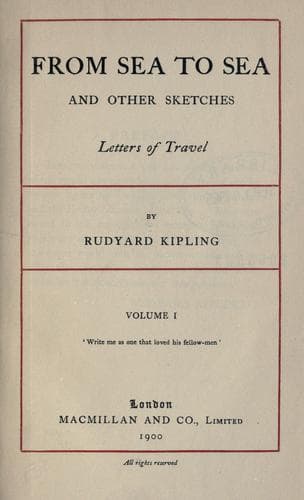
From Sea to Sea; Letters of TravelKipling, Rudyard
General
From Sea to Sea; Letters of Travel
Kipling, Rudyard
Asia -- Description and travel; Kipling, Rudyard, 1865-1936 -- Travel; United States -- Description and travel; Voyages and travels
The Grand is the Semi or Cottage Grand really, but you had better go
there unless a friend tells you of a better. A long course of good luck
has spoiled me for even average hotels. They are too fine and large at
the Grand, and they don't always live up to their grandeur; unlimited
electric bells, but no one in particular to answer 'em; printed menu,
but the first comers eat all the nice things, and so forth. None the
less there are points about the Grand not to be despised. It is modelled
on the American fashion, and is but an open door through which you may
catch the first gust from the Pacific slope. Officially, there are twice
as many English as Americans in the port. Actually, you hear no
languages but French, German, or American in the street. My experience
is sadly limited, but the American I have heard up to the present, is a
tongue as distinct from English as Patagonian.
A gentleman from Boston was kind enough to tell me something about it.
He defended the use of "I guess" as a Shakespearian expression to be
found in _Richard the Third_. I have learned enough never to argue with
a Bostonian.
"All right," I said, "I've never heard a real American say 'I guess';
but what about the balance of your extraordinary tongue? Do you mean to
say that it has anything in common with ours except the auxiliary verbs,
the name of the Creator, and Damn? Listen to the men at the next table."
"They are Westerners," said the man from Boston, as who should say
"observe this cassowary." "They are Westerners, and if you want to make
a Westerner mad tell him he is not like an Englishman. They think they
are like the English. They are awfully thin-skinned in the West. Now in
Boston it's different. _We_ don't care what the English people think of
us."
The idea of the English people sitting down to think about Boston, while
Boston on the other side of the water ostentatiously "didn't care," made
me snigger. The man told me stories. He belonged to a Republic. That was
why every man of his acquaintance belonged either "to one of the first
families in Boston" or else "was of good Salem stock, and his fathers
had come over in the _Mayflower_." I felt as though I were moving in the
midst of a novel. Fancy having to explain to the casual stranger the
blood and breeding of the hero of every anecdote. I wonder whether many
people in Boston are like my friend with the Salem families. I am going
there to see.
"There's no romance in America--it's all hard, business facts," said a
man from the Pacific slope, after I had expressed my opinion about some
rather curious murder cases which might have been called miscarriages of
justice. Ten minutes later, I heard him say slowly, _apropos_ of a game
called "Round the Horn" (this is a bad game. Don't play it with a
stranger.) "Well, it's a good thing for this game that Omaha came up.
Dice were invented in Omaha, and the man who invented 'em he made a
colossal fortune."
Public-domain text, read in full here on John Shaqi.
Reviews
Reviews
No reviews yet
Be the first to share your thoughts on this work.
Elsewhere in the archive
Join the Discussion
Join the discussion
Sign in to leave a comment or review.
Sign InorCreate an account