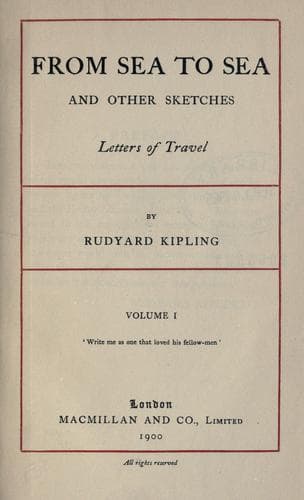
From Sea to Sea; Letters of TravelKipling, Rudyard
General
From Sea to Sea; Letters of Travel
Kipling, Rudyard
Asia -- Description and travel; Kipling, Rudyard, 1865-1936 -- Travel; United States -- Description and travel; Voyages and travels
That there was enormous elaboration in the picture, from the
ornamentation of the hair-pins to the graining of the clogs, did not
strike me till after the first five minutes, when I had sufficiently
admired the certainty of touch.
"Recollect there is no room for error in painting on silk," said the
proud possessor. "The line must stand under any circumstances. All that
is possible before painting is a little dotting with charcoal, which is
rubbed off with a feather-brush. Did he know anything about drapery or
colour or the shape of a woman? Is there any one who could teach him
more if he were alive to-day?"
Then we went to Nikko.
No. XIX
THE LEGEND OF NIKKO FORD AND THE STORY OF THE AVOIDANCE OF MISFORTUNE.
A rose-red city, half as old as Time.
Five hours in the train took us to the beginning of a 'rickshaw journey
of twenty-five miles. The guide unearthed an aged cart on Japanese
lines, and seduced us into it by promises of speed and comfort beyond
anything that a 'rickshaw could offer. Never go to Nikko in a cart. The
town of departure is full of pack-ponies who are not used to it, and
every third animal tries to get a kick at his friends in the shafts.
This renders progress sufficiently exciting till the bumpsomeness of the
road quenches all emotions save one. Nikko is reached through one avenue
of _cryptomerias_--cypress-like trees eighty feet high, with red or dull
silver trunks and hearse-plume foliage of darkest green. When I say one
avenue, I mean one continuous avenue twenty-five miles long, the trees
so close to each other throughout that their roots interlace and form a
wall of wood on either side of the sunken road. Where it was necessary
to make a village along the line of march,--that is to say once every
two or three miles,--a few of the giants had been wrenched out--as teeth
are wrenched from a full-planted jaw--to make room for the houses. Then
the trees closed up as before to mount guard over the road. The banks
between which we drove were alight with azaleas, camelias, and violets.
"Glorious! Stupendous! Magnificent!" sang the Professor and I in chorus
for the first five miles, in the intervals of the bumps. The avenue took
not the least notice of our praise except by growing the trees even more
closely together. "Vistas of pillared shade" are very pleasant to read
about, but on a cold day the ungrateful heart of man could cheerfully
dispense with a mile or two of it if that would shorten the journey. We
were blind to the beauty around; to the files of pack-ponies with manes
like hearth-brooms and the tempers of Eblis kicking about the path; to
the pilgrims with blue and white handkerchiefs on their heads, enviable
silver-grey leggings on their feet, and Buddha-like babies on their
backs; to the trim country drays pulled by miniature cart-horses
bringing down copper from the mines and _saki_ from the hills; to the
colour and movement in the villages where all the little children
Public-domain text, read in full here on John Shaqi.
Reviews
Reviews
No reviews yet
Be the first to share your thoughts on this work.
Elsewhere in the archive
Join the Discussion
Join the discussion
Sign in to leave a comment or review.
Sign InorCreate an account