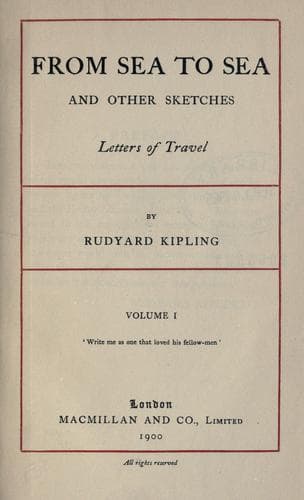
From Sea to Sea; Letters of TravelKipling, Rudyard
General
From Sea to Sea; Letters of Travel
Kipling, Rudyard
Asia -- Description and travel; Kipling, Rudyard, 1865-1936 -- Travel; United States -- Description and travel; Voyages and travels
Hounded on by the Professor, the guide sought me by banks of the river
and bade me "come and see temples." Then I fairly and squarely cursed
all temples, being stretched at my ease on some warm sand in the hollow
of a rock, and ignorant as the grass-shod cattle that tramped the
further bank. "Very fine temples," said the guide, "you come and see. By
and by temple be shut up because priests make half an hour more time."
Nikko time is half an hour ahead of the standard, because the priests of
the temples have discovered that travellers arriving at three p.m. try
to do all the temples before four--the official-hour of closing. This
defrauds the church of her dues, so her servants put the clock on, and
Nikko, knowing naught of the value of time, is well content.
When I cursed the temples I did a foolish thing, and one for which this
poor pen can never make fitting reparation. We went up a hill by way of
a flight of grey stone slabs. The _cryptomerias_ of the Nikko road were
as children to the giants that overshadowed us here. Between their
iron-grey boles were flashes of red--the blood-red of the Mikado's
bridge. That great king who killed the beggar at the ford had been well
pleased with the success of his experiment. Passing under a mighty stone
arch we came into a square of splendour alive with the sound of hammers.
Thirty or forty men were tapping the pillars and steps of a carnelian
shrine heavy with gold. "That," said the guide, impassively, "is a
godown. They are renewing the lacquer. First they extract it."
Have you ever "extracted" lacquer from wood? I smote the foot of a
pillar with force, and after half a dozen blows chipped off one small
fragment of the stuff, in texture like red horn. Betraying no surprise,
I demanded the name of a yet more magnificent shrine across the
courtyard. It was red lacquered like the others, but above its main door
were carved in open work three apes--one with his hands to his ears,
another covering his mouth, and a third blinding his eyes.
"That place," said the guide, "used to be a stable when the Daimio kept
his horses there. The monkeys are the three who hear no wrong, say no
wrong, and see no wrong."
"Of course," I said. "What a splendid device for a stable where the
grooms steal the grain!" I was angry because I had grovelled before a
godown and a stable, though the round world cannot hold their equals.
We entered a temple, or a tomb, I do not know which, through a gateway
of carven pillars. Eleven of them bore a running pattern of trefoil--the
apex pointing earthward--the twelfth had its pattern reversed.
"Make 'em all the same--no good," said the guide, emphatically.
"Something sure to come bad by an' by. Make one different all right.
Save him so. Nothing happen then."
Public-domain text, read in full here on John Shaqi.
Reviews
Reviews
No reviews yet
Be the first to share your thoughts on this work.
Elsewhere in the archive
Join the Discussion
Join the discussion
Sign in to leave a comment or review.
Sign InorCreate an account