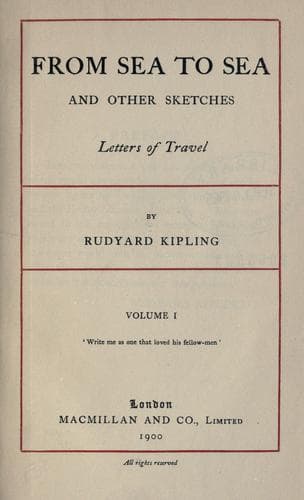
From Sea to Sea; Letters of TravelKipling, Rudyard
General
From Sea to Sea; Letters of Travel
Kipling, Rudyard
Asia -- Description and travel; Kipling, Rudyard, 1865-1936 -- Travel; United States -- Description and travel; Voyages and travels
Round each temple stood a small army of priceless bronze or stone
lanterns, stamped, as was everything else, with the three leaves that
make the Daimio's crest. The lanterns were dark green or lichened grey,
and in no way lightened the gloom of the red. Down below, by the sacred
bridge, I believed red was a joyous colour. Up the hillside under the
trees and the shadow of the temple eaves I saw that it was the hue of
sorrow. When the great king killed the beggar at the ford he did not
laugh, as I have said. He was very sorry, and said: "Art is Art, and
worth any sacrifice. Take that corpse away and pray for the naked soul."
Once, in one of the temple courtyards, nature dared to rebel against the
scheme of the hillside. Some forest tree, all unimpressed by the
_cryptomerias_, had tossed a torrent of tenderest pink flowers down the
face of a grey retaining wall that guarded a cutting. It was as if a
child had laughed aloud at some magnificence it could not understand.
"You see that cat?" said the guide, pointing out a pot-bellied pussy
painted above a door. "That is the Sleeping Cat. The artist he paint it
left-handed. We are proud of that cat."
"And did they let him remain left-handed after he had painted that
thing?"
"Oh yes. You see he was always left-handed."
The infinite tenderness of the Japanese towards their children extends,
it would seem, even to artists. Every guide will take you to see the
Sleeping Cat. Don't go. It is bad. Coming down the hill, I learned that
all Nikko was two feet under snow in the winter, and while I was trying
to imagine how fierce red, white, and black-green would look under the
light of a winter sun I met the Professor murmuring expletives of
admiration.
"What have you done? What have you seen?" said he.
"Nothing. I've accumulated a lot of impressions of no use to any one but
the owner."
"Which means you are going to slop over for the benefit of the people in
India," said the Professor.
And the notion so disgusted me that I left Nikko that very afternoon,
the guide clamouring that I had not seen half its glories. "There is a
lake," he said; "there are mountains. You must go see!"
"I will return to Tokio and study the modern side of Japan. This place
annoys me because I do not understand it."
"Yet I am _the_ good guide of Yokohama," said the guide.
No. XX
SHOWS HOW I GROSSLY LIBELLED THE JAPANESE ARMY, AND EDITED A CIVIL AND
MILITARY GAZETTE WHICH IS NOT IN THE LEAST TRUSTWORTHY.
"And the Duke said, 'Let there be cavalry,' and there were
cavalry. And he said, 'Let them be slow,' and they were slow,
d----d slow; and the Japanese Imperial Horse called he them."
Public-domain text, read in full here on John Shaqi.
Reviews
Reviews
No reviews yet
Be the first to share your thoughts on this work.
Elsewhere in the archive
Join the Discussion
Join the discussion
Sign in to leave a comment or review.
Sign InorCreate an account