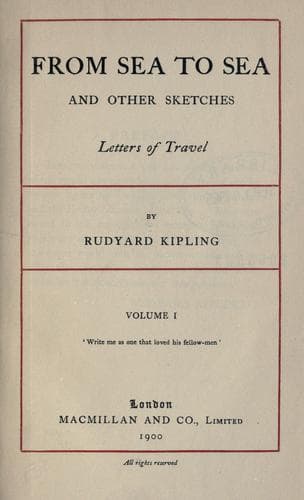
From Sea to Sea; Letters of TravelKipling, Rudyard
General
From Sea to Sea; Letters of Travel
Kipling, Rudyard
Asia -- Description and travel; Kipling, Rudyard, 1865-1936 -- Travel; United States -- Description and travel; Voyages and travels
"Because he didn't invite me, and, anyhow, he wears Europe clothes--so
does the Empress--so do all the Court people. Let's sit down and
consider things. This people puzzles me."
And I told my story of the interview with the Editor of the _Tokio
Public Opinion_. The Professor had been making investigation into the
Educational Department. "And further," said he at the end of the tale,
"the ambition of the educated student is to get a place under
Government. Therefore he comes to Tokio: will accept any situation at
Tokio that he may be near to his chance."
"Whose son is that student?"
"Son of the peasant, yeoman farmer, and shopkeeper, _ryot_, _tehsildar_,
and _bunnia_. While he waits he imbibes Republican leanings on account
of the nearness of Japan to America. He talks and writes and debates,
and is convinced he can manage the Empire better than the Mikado."
"Does he go away and start newspapers to prove that?"
"He may; but it seems to be unwholesome work. A paper can be suspended
without reason given under the present laws; and I'm told that one
enterprising editor has just got three years' simple imprisonment for
caricaturing the Mikado."
"Then there is yet hope for Japan. I can't quite understand how a people
with a taste for fighting and quick artistic perceptions can care for
the things that delight our friends in Bengal."
"You make the mistake of looking on the Bengali as unique. So he is in
his own peculiar style; but I take it that the drunkenness of Western
wine affects all Oriental folk in much the same way. What misleads you
is that very likeness. Followest thou? Because a Jap struggles with
problems beyond his grip in much the same phraseology as a Calcutta
University student, and discusses Administration with a capital A, you
lump Jap and Chatterjee together."
"No, I don't. Chatterjee doesn't sink his money in railway companies, or
sit down and provide for the proper sanitation of his own city, or of
his own notion cultivate the graces of life, as the Jap does. He is like
the _Tokio Public Opinion_--'purely political.' He has no art whatever,
he has no weapons, and there is no power of manual labour in him. Yet he
is like the Jap in the pathos of his politics. Have you ever studied
Pathetic Politics? _Why_ is he like the Jap?"
"Both drunk, I suppose," said the Professor. "Get that girl to give back
your gig-lamps, and you will be able to see more clearly into the soul
of the Far East."
Public-domain text, read in full here on John Shaqi.
Reviews
Reviews
No reviews yet
Be the first to share your thoughts on this work.
Elsewhere in the archive
Join the Discussion
Join the discussion
Sign in to leave a comment or review.
Sign InorCreate an account