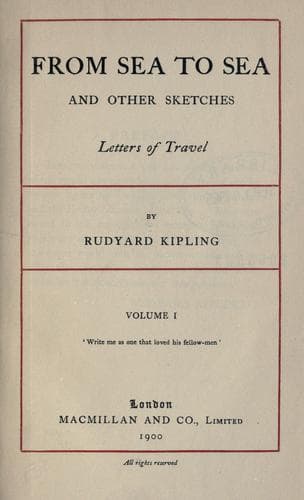
From Sea to Sea; Letters of TravelKipling, Rudyard
General
From Sea to Sea; Letters of Travel
Kipling, Rudyard
Asia -- Description and travel; Kipling, Rudyard, 1865-1936 -- Travel; United States -- Description and travel; Voyages and travels
When he had departed it struck me that, in the language of the East, "he
might have been pulling my leg." But there remained no doubt whatever as
to his skill with the weapon he excused so tenderly.
I put the case before the Professor. "We will go to America before you
forejudge it altogether," said he. "To America in an American ship will
we go, and say good-by to Japan." That night we counted the gain of our
sojourn in the Land of Little Children more closely than many men count
their silver. Nagasaki with the grey temples, green hills, and all the
wonder of a first-seen shore; the Inland Sea, a thirty-hour panorama of
passing islets drawn in grey and buff and silver for our delight; Kobé,
where we fed well and went to a theatre; Osaka of the canals and the
peach blossom; Kioto--happy, lazy, sumptuous Kioto, and the blue rapids
and innocent delights of Arashima; Otzu on the shoreless, rainy lake;
Myanoshita in the hills; Kamakura by the tumbling Pacific, where the
great god Buddha sits and equably hears the centuries and the seas
murmur in his ears; Nikko, fairest of all places under the sun; Tokio,
the two-thirds civilised and altogether progressive warren of humanity;
and composite Franco-American Yokohama; we renewed them all, sorting out
and putting aside our special treasures of memory. If we stayed longer,
we might be disillusioned, and yet--surely, that would be impossible.
"What sort of mental impression do you carry away?" said the Professor.
"A tea-girl in fawn-coloured crêpe under a cherry tree all blossom.
Behind her, green pines, two babies, and a hog-backed bridge spanning a
bottle-green river running over blue boulders. In the foreground a
little policeman in badly fitting Europe clothes drinking tea from blue
and white china on a black lacquered stand. Fleecy white clouds above
and a cold wind up the street," I said, summarising hastily.
"Mine is a little different. A Japanese boy in a flat-headed German cap
and baggy Eton jacket; a King taken out of a toy-shop, a railway taken
out of a toy-shop, hundreds of little Noah's Ark trees and fields made
of green-painted wood. The whole neatly packed in a camphor-wood box
with an explanatory book called the Constitution--price twenty cents."
"You looked on the darker side of things. But what's the good of writing
impressions? Every man has to get his own at first hand. Suppose I give
an itinerary of what we saw?"
"You couldn't do it," said the Professor, blandly. "Besides, by the
time the next Anglo-Indian comes this way there will be a hundred more
miles of railway and all the local arrangements will have changed. Write
that a man should come to Japan without any plans. The guide-books will
tell him a little, and the men he meets will tell him ten times more.
Let him get first a good guide at Kobé, and the rest will come easily
enough. An itinerary is only a fresh manifestation of that unbridled
egoism which--"
Public-domain text, read in full here on John Shaqi.
Reviews
Reviews
No reviews yet
Be the first to share your thoughts on this work.
Elsewhere in the archive
Join the Discussion
Join the discussion
Sign in to leave a comment or review.
Sign InorCreate an account