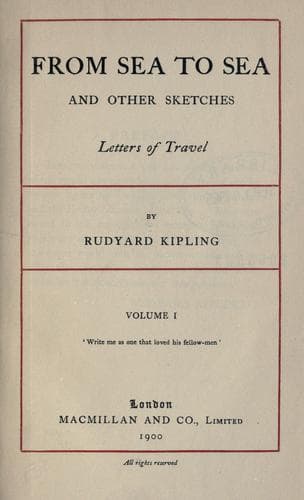
From Sea to Sea; Letters of TravelKipling, Rudyard
General
From Sea to Sea; Letters of Travel
Kipling, Rudyard
Asia -- Description and travel; Kipling, Rudyard, 1865-1936 -- Travel; United States -- Description and travel; Voyages and travels
I thought he would have smitten me, but he didn't. He explained that no
one ever used the word "street," and that every one was supposed to know
how the streets run; for sometimes the names were upon the lamps and
sometimes they weren't. Fortified with these directions I proceeded till
I found a mighty street full of sumptuous buildings four or five stories
high, but paved with rude cobble stones in the fashion of the Year One.
A cable-car without any visible means of support slid stealthily behind
me and nearly struck me in the back. A hundred yards further there was a
slight commotion in the street--a gathering together of three or
four--and something that glittered as it moved very swiftly. A ponderous
Irish gentleman with priest's cords in his hat and a small nickel-plated
badge on his fat bosom emerged from the knot, supporting a Chinaman who
had been stabbed in the eye and was bleeding like a pig. The bystanders
went their ways, and the Chinaman, assisted by the policeman, his own.
Of course this was none of my business, but I rather wanted to know what
had happened to the gentleman who had dealt the stab. It said a great
deal for the excellence of the municipal arrangements of the town that a
surging crowd did not at once block the street to see what was going
forward. I was the sixth man and the last who assisted at the
performance, and my curiosity was six times the greatest. Indeed, I felt
ashamed of showing it.
There were no more incidents till I reached the Palace Hotel, a
seven-storied warren of humanity with a thousand rooms in it. All the
travel-books will tell you about hotel arrangements in this country.
They should be seen to be appreciated. Understand clearly--and this
letter is written after a thousand miles of experiences--that money
will not buy you service in the West.
When the hotel clerk--the man who awards your room to you and who is
supposed to give you information--when that resplendent individual
stoops to attend to your wants, he does so whistling or humming, or
picking his teeth, or pauses to converse with some one he knows. These
performances, I gather, are to impress upon you that he is a free man
and your equal. From his general appearance and the size of his diamonds
he ought to be your superior. There is no necessity for this swaggering,
self-consciousness of freedom. Business is business, and the man who is
paid to attend to a man might reasonably devote his whole attention to
the job.
Public-domain text, read in full here on John Shaqi.
Reviews
Reviews
No reviews yet
Be the first to share your thoughts on this work.
Elsewhere in the archive
Join the Discussion
Join the discussion
Sign in to leave a comment or review.
Sign InorCreate an account