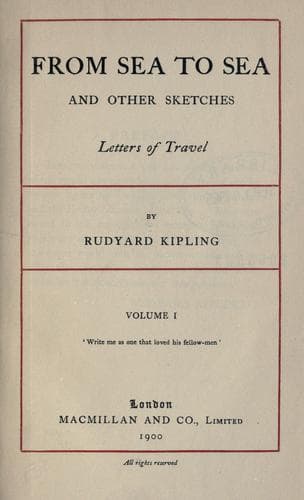
From Sea to Sea; Letters of TravelKipling, Rudyard
General
From Sea to Sea; Letters of Travel
Kipling, Rudyard
Asia -- Description and travel; Kipling, Rudyard, 1865-1936 -- Travel; United States -- Description and travel; Voyages and travels
capered under his pink, Roman nose, kicking up as much dust as the
_Foxhall_ colt who had got on to a lovely patch of sand and was dancing
a saraband in it. In and out of the tangle, going down to or coming back
from the courses, ran, shuffled, rocketed, plunged, sulked, or stampeded
countless horses of all kinds, shapes, and descriptions--so that the eye
at last failed to see what they were, and only retained a general
impression of a whirl of bays, greys, iron greys, and chestnuts with
white stockings, some as good as could be desired, others average, but
not one distinctly bad.
"We have no downright bad 'uns in this stable. What's the use?" said the
Master of Horse, calmly. "They are all good beasts and, one with
another, must cost more than a thousand rupees each. This year's new
ones bought from Bombay and the pick of our own studs are a hundred
strong about. May be more. Yes, they look all right enough; but you can
never know what they are going to turn out. Live-stock is very
uncertain." "And how are the stables managed? how do you make room for
the fresh stock?" Something this way. Here are all the new ones and
Parrott's lot, and the English colts that Maharaja Pertab Singh brought
out with him from Home. _Winterlake_ out o' _Queen's Consort_ that
chestnut is with the two white stockings you're looking at now. Well,
next hot weather we shall see what they're made of and which is who.
There's so many that the trainer hardly knows 'em one from another till
they begin to be a good deal forward. Those that haven't got the pace,
or that the Maharaja don't fancy, they're taken out and sold for what
they'll bring. The man who takes the horses out has a good job of it. He
comes back and says: "I sold such and such for so much, and here's the
money." That's all. Well, our rejections are worth having. They have
taken prizes at the Poona Horse Show. See for yourself. Is there one of
those that you wouldn't be glad to take for a hack, and look well after
too? Only they're no use to us, and so out they go by the score. We've
got sixty riding-boys, perhaps more, and they've got their work cut out
to keep them all going. What you've seen are only the stables. We've got
one stud at Bellara, eighty miles out, and they come in sometimes in
droves of three and four hundred from the stud. They raise Marwaris
there too, but that's entirely under native management. We've got
nothing to do with that. The natives reckon a Marwari the best
country-bred you can lay hands on; and some of them are beauties! Crests
on 'em like the top of a wave. Well, there's that stud and another stud
and, reckoning one with another, I should say the Maharaja has nearer
twelve hundred than a thousand horses of his own. For this place here,
two wagon-loads of grass come in every day from Marwar Junction. Lord
knows how many saddles and bridles we've got. I never counted. I suppose
we've about forty carriages, not counting the ones that get shabby and
Public-domain text, read in full here on John Shaqi.
Reviews
Reviews
No reviews yet
Be the first to share your thoughts on this work.
Elsewhere in the archive
Join the Discussion
Join the discussion
Sign in to leave a comment or review.
Sign InorCreate an account