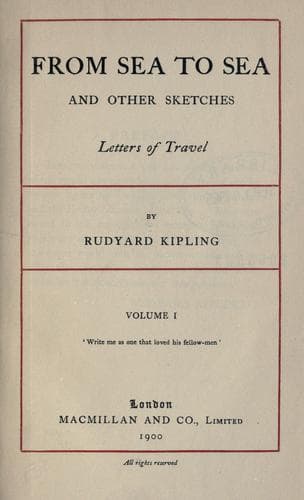
From Sea to Sea; Letters of TravelKipling, Rudyard
General
From Sea to Sea; Letters of Travel
Kipling, Rudyard
Asia -- Description and travel; Kipling, Rudyard, 1865-1936 -- Travel; United States -- Description and travel; Voyages and travels
Everything was repacked and rebound with triple ropes, and the Sahib was
provided with an extra cushion; but he had reached a sort of dreamsome
Nirvana, having several times bitten his tongue through, cut his boot
against the wheel-edge, and twisted his legs into a true-lovers'-knot.
There was no further sense of suffering in him. He was even beginning to
enjoy himself faintly and by gasps. The road struck boldly into hills
with all their teeth on edge, that is to say, their strata breaking
across the road in little ripples. The effect of this was amazing. The
tonga skipped merrily as a young fawn, from ridge to ridge. It shivered,
it palpitated, it shook, it slid, it hopped, it waltzed, it ricochetted,
it bounded like a kangaroo, it blundered like a sledge, it swayed like a
top-heavy coach on a down-grade, it "kicked" like a badly coupled
railway carriage, it squelched like a country-cart, it squeaked in its
torment, and lastly, it essayed to plough up the ground with its nose.
After three hours of this performance, it struck a tiny little ford, set
between steeply sloping banks of white dust, where the water was clear
brown and full of fish. And here a blissful halt was called under the
shadow of the high bank of a tobacco field.
Would you taste one of the real pleasures of Life? Go through severe
acrobatic exercises in and about a tonga for four hours; then, having
eaten and drank till you can no more, sprawl in the cool of a nullah bed
with your head among the green tobacco, and your mind adrift with the
one little cloud in a royally blue sky. Earth has nothing more to offer
her children than this deep delight of animal well-being. There were
butterflies in the tobacco--six different kinds, and a little rat came
out and drank at the ford. To him succeeded the flight into Egypt. The
white banks of the ford framed the picture perfectly--the Mother in
blue, on a great white donkey, holding the Child in her arms, and Joseph
walking beside, his hand upon the donkey's withers. By all the laws of
the East, Joseph should have been riding and the Mother walking. This
was an exception decreed for the Englishman's special benefit. It was
very warm and very pleasant, and, somehow, the passers by the ford grew
indistinct, and the nullah became a big English garden, with a cuckoo
singing far down in the orchard, among the apple-blossoms. The cuckoo
started the dream. He was the only real thing in it, for on waking the
garden slipped back into the water, but the cuckoo remained and called
and called for all the world as though he had been a veritable English
cuckoo. "Cuckoo--cuckoo--cuck;" then a pause and renewal of the cry from
another quarter of the horizon. After that the ford became distasteful,
so the procession was driven forward and in time plunged into what must
have been a big city once, but the only inhabitants were oil-men. There
were abundance of tombs here, and one carried a life-like carving in
Public-domain text, read in full here on John Shaqi.
Reviews
Reviews
No reviews yet
Be the first to share your thoughts on this work.
Elsewhere in the archive
Join the Discussion
Join the discussion
Sign in to leave a comment or review.
Sign InorCreate an account