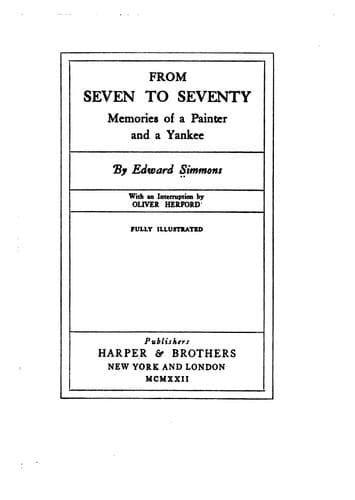
From Seven to Seventy: Memories of a Painter and a YankeeSimmons, Edward
General
From Seven to Seventy: Memories of a Painter and a Yankee
Simmons, Edward
Artists -- Biography
We went to see the historical sights of London, and you were
particularly moved in Westminster Abbey. As we stood in the corridor
outside, you made a solemn prediction to this effect: “Twenty or
thirty years from now, when Germany conquers France, as she surely
will unless England has the sense to step in in time—she will then
try to conquer England. This she can do, unless America comes to the
rescue. When Americans face the destruction of Westminster Abbey,
they _will_ come to the rescue. Then at last the war of 1775 will
come to an end.”
On one occasion, while entering the city by the railway (I was feeling
fine from a reinforcement of several real old Scotch whiskies), I took
out a coin, a penny, and said:
“This is a wonderful country. I no sooner get here than for a couple of
our copper cents (with a picture of an Indian, badly done, upon the
face) I receive this large, weighty, and dignified coin of pure bronze
upon which is a bas-relief of Her Gracious Majesty, Queen Victoria.”
From the other side of the compartment leaned forward a retired British
major—a man you could see had evidently conquered with difficulty his
childish habit of dropping his aitches. In a gentle, deprecating voice,
he answered:
“My dear young sir, permit me to hope that during your stay with us here
you will refrain from any desire to make a mock of our holier
institutions. Do not, I pray you, carp at Our Gracious Majesty.”
He did not get down on his belly on the floor—only mentally—but I had
the awful feeling that he was longing to do so. Queen Victoria (and that
was long before the admirable book by Lytton Strachey) could never
produce such an effect upon a sane Yankee.
Speaking of aitches, I once told Leslie Stephen that every Englishman
was careless with them, even himself. He roared and insisted that only
the lower classes dropped them or added them. I then asked him to say,
“White witch which I met on the Isle of Wight.” Of course he stumbled.
This softening of the aitch to a point where it seems to disappear is a
habit peculiar to the inbred Britisher—just as the “r” is to the
Bostonian and the “d” to the Spaniard.
I once discussed this with an educated and learned Englishman from the
commoner class. He was only a graduate of the College of London, but
knew his Latin and Greek better than any American and had been spending
his time teaching the children of the vulgar rich of Pittsburgh. He
insisted that the habit of dropping the aitches was prevalent in those
parts of England where the Romans had permanently settled—all along
inside the Wall. He cited a poem of Catullus which mocked at the
fashionable dudes of Rome for the foolish habit they had taken up of
dropping and adding their aitches. If this were the fashion in the
mother country, it would certainly have penetrated to the Roman settlers
of England.
Public-domain text, read in full here on John Shaqi.
Reviews
Reviews
No reviews yet
Be the first to share your thoughts on this work.
Elsewhere in the archive
Join the Discussion
Join the discussion
Sign in to leave a comment or review.
Sign InorCreate an account