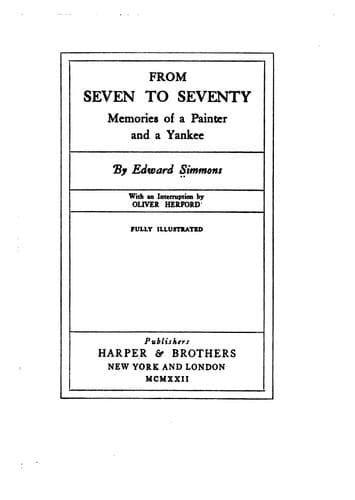
From Seven to Seventy: Memories of a Painter and a YankeeSimmons, Edward
General
From Seven to Seventy: Memories of a Painter and a Yankee
Simmons, Edward
Artists -- Biography
The army officers who were stationed at one place or another about the
fair grounds or who came to Chicago as visitors always managed to drift
in with us artists. They were a jolly crowd, and there was one or more
in at every one of our frivolities. There was one colonel—I cannot think
of him by name, but as the man who always began a story or an address
with, “As I was about to remark when rudely interrupted by the gentleman
on my left....” We had a joke which we tried on each newcomer—namely,
that of seizing our chairs, straddling them, and running madly around
the table striving to ride him down. We tried it on the colonel only
once. He immediately grabbed his chair, did not join us, but jumped with
it upon the table, riding down the middle and smashing everything as he
went.
One officer, an impulsive, big creature, had been colonel of an Indian
regiment, and another was the commander of the Buffaloes. I asked them
to compare the character of the two races as soldiers. I was told that
the negro was perfect, if led by a white man, but an officer could never
make an intimate friend of one. On the contrary, the Indian was not
perfect until he was in a fight, and then the white man must know enough
to let him alone. An officer always made intimate friends among them,
and he could eat and sleep with them as he would with his brother. The
Indian is an inbred man and can be the friend of any other inbred man
(aristocrat).
One night I went with Captain Maney to the Electrical Building; he had
charge of the comfort of the ten thousand troops quartered there. As we
entered, three noncommissioned officers came up, saluting, to ask for
instructions. One was an Irishman—an alien; one was a negro—a freed
slave; and the third was an Indian—an aborigine. The colonel himself had
been an officer of the South in the Civil War and was a pardoned rebel.
This could never have happened in any other army in the history of the
world, unless perhaps in ancient Rome. They might have had the freed
slave, the alien, and Cataline (the rebel), but I don’t think they could
have produced an aborigine soldier.
We artists of the Exposition were given a very smart banquet by the
Chamber of Commerce of Chicago. This brought to mind a story which I
told to Mr. Armour, much to his delight. A young girl calls on a woman
friend and talks to her little boy, who is taking care of his baby
sister in the carriage. She says to him:
[Illustration:
“JUSTICE”
Center Panel by Edward Simmons, Criminal Courts Building, New York
_Copyright by Edward Simmons; from a Copley Print_
_Copyright by Curtis & Cameron, Publishers, Boston_
]
“Won’t you give the baby to me and you can come and see her at my
house?”
“No,” he answered, “she’d starve to death. Your dress buttons behind.”
Public-domain text, read in full here on John Shaqi.
Reviews
Reviews
No reviews yet
Be the first to share your thoughts on this work.
Elsewhere in the archive
Join the Discussion
Join the discussion
Sign in to leave a comment or review.
Sign InorCreate an account