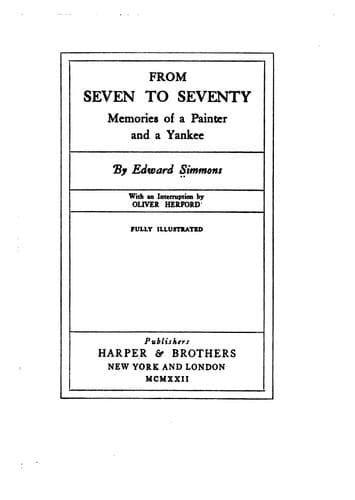
From Seven to Seventy: Memories of a Painter and a YankeeSimmons, Edward
General
From Seven to Seventy: Memories of a Painter and a Yankee
Simmons, Edward
Artists -- Biography
The color scheme of the whole room was left to me and I did the best I
could with it, also outlining the panels with gold bands. Alas! as years
went on, some politician, instead of leaving time to mellow it to a
beautiful tone, has seen fit to retint the walls and—worse and worse—he
has large plates with labels to each picture. You may as well write
“horse” under a drawing of the animal as to put “Justice” under my
panel. If a decoration is not intelligible to a Chinaman, there is no
reason for putting it up.
The Municipal Art Committee had a grand unveiling of the work, with
Joseph Choate to make the address of presentation and the acceptance for
the city by the District Attorney. Mr. Choate arrived early and got
quite a few data from me. It may have been something about my manner,
but I think it was his own disposition—which encouraged, became
malignant, like the clown that slaps the face of the little boy who
cries when his red apple is stolen from him; he spied me in the farthest
corner, where I had retired to be out of view. Then, in his oiliest and
most oratorical manner, he declaimed:
“Greece had her Apelles, we have our Simmons; Rome had her Michael
Angelo, we have our Simmons; etc.”
The crowd applauded, but he knew that I would get the sting; it was as
if he were speaking to me alone and I never forgave him.
[Illustration:
“THE THREE FATES”
Right panel by Edward Simmons, Criminal Courts Building, New York
_Copyright by Edward Simmons; from a Copley Print, Copyright by Curtis
& Cameron, Publishers, Boston_
]
Chapter X: Democracy and the Fine Arts
Money, commerce and the Protestant faith have been drawbacks to the
progress of the fine arts in America—the last do not believe in beauty,
as do the Roman Catholics. Better than Mohammedanism, though, whose
Koran does not allow the right of man to copy even the meanest of
God-made creatures, the Eastern art is a constant struggle between
religion and the desire to make representations of living things.
Autocracy’s motto—”_væ victis_,” or to the devil with the hindmost—is
the proper one for the fine arts. The taste of a whole community is the
dead level of mediocrity, and a proof of the scant attention paid to art
in America is the place given it in the newspapers—before the fashions
and after the dog fights.
Last week a statue of General Grant was unveiled with much celebration.
Although the sculptor who made it had spent fifteen years of his life
doing the work, there was no mention of his name in the account in the
papers, but the wives of the Senators and Congressmen present were
featured by photographs in the Sunday supplements. In France it is
different. The committee would probably be mentioned first, but the
artist’s name would come second. Public opinion rules, and the arts will
come back when the people want them; and then the fact will be recorded
on that thermometer—the newspapers.
Public-domain text, read in full here on John Shaqi.
Reviews
Reviews
No reviews yet
Be the first to share your thoughts on this work.
Elsewhere in the archive
Join the Discussion
Join the discussion
Sign in to leave a comment or review.
Sign InorCreate an account