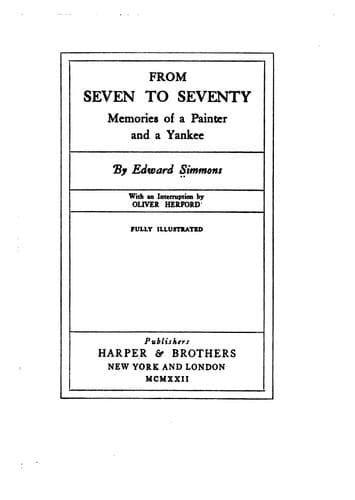
From Seven to Seventy: Memories of a Painter and a YankeeSimmons, Edward
General
From Seven to Seventy: Memories of a Painter and a Yankee
Simmons, Edward
Artists -- Biography
There were many other reasons why we did not have a good show. One was
the number of jurymen who had favorite pupils and must have a place for
their work. Most of these we succeeded in eliminating, but they crept in
in spite of us. I remember one man telling us of a beautiful girl, one
of the capital F’s of the F. F. V.’s of Virginia (whose family had been
stricken with poverty by the Civil War), now supporting her invalid
mother by her art—not a word about the merit of the work. We had
rejected a portrait by the young lady, but took it back, not on account
of the story, but because it was so offensive to see this particular
juryman weep about it.
Then there were the indignant American citizens who appealed to the
ambassador over our decisions. The United States government had given us
the final power of acceptance or refusal, but overrode us in a number of
cases. A noted American sculptor, whose position socially was
unimpeachable, but whose work was fundamentally “rotten,” had gone so
far as to have his several groups of large statuary placed where he
thought they should eventually rest, and there was consternation when we
refused them. A member of the jury tackled Alexander Harrison and myself
on the subject one night with the argument that we were in duty bound to
recognize the work of a man so highly placed socially.
Harrison replied: “You may think that in talking to Simmons and me you
are speaking to two gentlemen with social position. But you are not; you
are only talking to two Puritans. We do not think it is right.”
But the American government stepped in and the sculpture was duly
accepted.
In another case the ambassador came to us with a pathetic appeal for
protection, asking us to reconsider our opinion of a portrait we had
rejected.
“The lady who painted it sleeps on my doormat,” he said, “and she’s got
to be removed.” With laughter we took it back.
Once in Philadelphia I was one of a committee that was to decide a
competition for the decoration of one of the public buildings. It was a
great plum, for in addition to the actual payment for the work, the
winner was to get a prize of two thousand dollars for his proposition.
All through our meeting I felt a strange and subtle influence at work,
although I must confess I was not approached or asked to use my vote in
any way for any contestant. Edwin Abbey had sent a sketch, very good,
but the charming part of it had been done by a young architect in London
and it was very doubtful that it would keep its beauty if carried out in
a large design. The majority decided for a younger painter, and the
award was given to him. Right after the decision there was a large
reception at the home of George W. Elkins, who, if I mistake not, had
given the prize. I shall never forget his look of surprise and then
chagrin as we filed in and announced our decision.
“Why,” he said, “I thought it had been all arranged that Abbey was to
have it.”
Public-domain text, read in full here on John Shaqi.
Reviews
Reviews
No reviews yet
Be the first to share your thoughts on this work.
Elsewhere in the archive
Join the Discussion
Join the discussion
Sign in to leave a comment or review.
Sign InorCreate an account