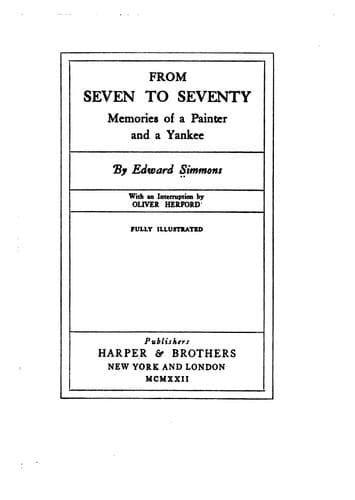
From Seven to Seventy: Memories of a Painter and a YankeeSimmons, Edward
General
From Seven to Seventy: Memories of a Painter and a Yankee
Simmons, Edward
Artists -- Biography
I believe that Stanford set the fashion here of building to our
latitude. We had formerly copied the British in our homes, using red
brick or brownstone, with small windows, reps curtains, and nailed-down
carpets of warm dark brown and scarlet—the stuff of the north for New
York City, which is the latitude of Madrid. The change was to blond
brick, marble, or Missouri limestone for the outside; and stone or
polished floors, Turkish rugs or mats for the inside, with a decided
lightening of the color scheme, so much so that a great “gag” was to
call the firm “McKim, White, and Gold.” To show that most of their
tendencies were for light interiors, a remark of Stanford’s can be
quoted. He told a woman, for whom he had just finished an ivory-colored
room, when she asked him what to put on the walls, “Oh, any color as
long as it is red.” Any painter knows that, given white as a background,
the only color one can trust the average citizen with is red. It takes
an artist to put blue and white or green and white together; and some
one with a Whistlerian feeling to put black and white together; but a
child can use red and white.
Nothing could be more different in style than the buildings Stanford
designed—the Madison Square Garden, the Metropolitan Club, Doctor
Parkhurst’s Church (which has now been torn down), or any of his
business buildings, are each made for the things they were to house. His
personal tastes were absolutely under the control of his artistic
feelings, and his sensitiveness was so great that he could lose his own
personality. When he fitted up his own house in Gramercy Park, the music
room was not his, it belonged to his family and their friends, and he
made it more beautifully classic than anything I have seen in North
America. A flight or two up was his own room. Vercingetorix in his cave
with all his spoils piled up around him! Everything he cared about (and
he wanted it at once) and a heterogeneous mass of priceless books,
paintings, draperies, all in a careless disorder, was happiness to him
in his own den.
I was in The Players when Stanny returned from his trip to Virginia,
having been asked to restore the principal building of the university,
which had been designed and built by Thomas Jefferson. As we sat
together over something to drink he seemed to be puzzled, confused, and
silent. I asked him what was the matter. He started and came out of his
mood, saying it was the job down South. “I’ve seen _his_ plans,” he
said, speaking with great deference. “They’re wonderful and I am scared
to death. I only hope I can do it right.” This left me with a conception
of the greatness of Jefferson in another rôle of which I was
ignorant—his architectural side. He is constantly impressing me as our
first American—an artist and, like all the big ones, a true democrat. He
represented the ideas of to-day and was farsighted enough to know they
were coming.
Public-domain text, read in full here on John Shaqi.
Reviews
Reviews
No reviews yet
Be the first to share your thoughts on this work.
Elsewhere in the archive
Join the Discussion
Join the discussion
Sign in to leave a comment or review.
Sign InorCreate an account