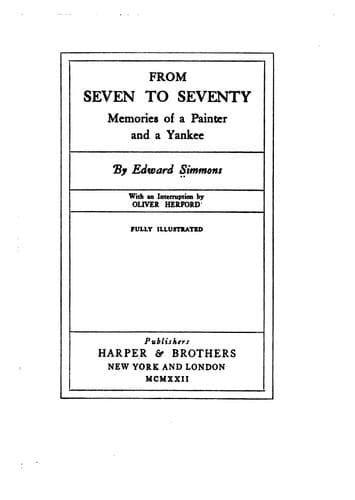
From Seven to Seventy: Memories of a Painter and a YankeeSimmons, Edward
General
From Seven to Seventy: Memories of a Painter and a Yankee
Simmons, Edward
Artists -- Biography
Mrs. Van Rensselaer wrote a long article somewhere about the Madison
Square building and gushed about that rare quality in the architects who
would go so far as even to vary the color of their bricks in
constructing the tower, so as to give it variance of tonality. This
seemed to me improbable, and one day I asked Meade about it. He said it
was “rot,” that if one of the brickmakers had not gone bankrupt, the
tower would have been the same color all the way up. I commented upon
the hideous color of the combination of brickwork and terra cotta
produced both in this building and in the Herald Building at
Thirty-fifth Street. Stanny told me not to be silly, but to wait until
they were twenty years old. Remembering it the other day, I looked, and,
behold! the tonality and color in the Madison Square building had come
together like smoothing velvet.
The first attempt at the statue on the top failed by reason of the fact
that the drapery which flew from the shoulder, and served as a tail or
rudder, did not accomplish its purpose of turning her arrow into the eye
of the wind. Saint-Gaudens (the sculptor) and Stanny spent some
thousands of dollars in taking it down and making a new one. The second
worked as a weathercock, but, alas! it was not half so beautiful. To-day
the drapery over which they spent so much time and money is gone. So
much does America care for its art and its artists!
One should not judge Stanford White’s ability as an architect by the
Washington Arch which stands at the foot of Fifth Avenue. The temporary
arch which preceded this one was put up in lath and plaster—staff—to
celebrate a memorial occasion, and was rarely beautiful in structure and
proportion. The city fathers asked him to reproduce it for permanence in
marble. He told them it could not be done, but after much argument he
gave in. I suppose it was a question of bearing power or stress, but he
did not succeed. Very few men have ever been able to alter—to their own
satisfaction, or to that of the public—their first inspiration. A “dub”
can; an artist can’t. The Washington Arch stands to-day, as many other
buildings in America do, a monument to the interference with an artist’s
dream.
Public-domain text, read in full here on John Shaqi.
Reviews
Reviews
No reviews yet
Be the first to share your thoughts on this work.
Elsewhere in the archive
Join the Discussion
Join the discussion
Sign in to leave a comment or review.
Sign InorCreate an account