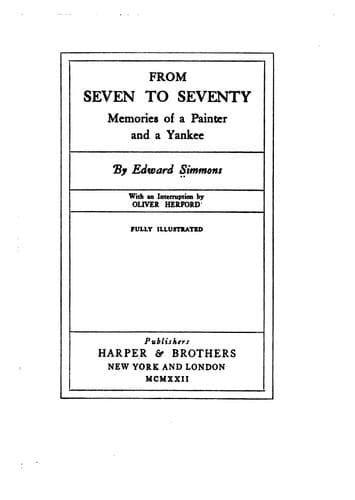
From Seven to Seventy: Memories of a Painter and a YankeeSimmons, Edward
General
From Seven to Seventy: Memories of a Painter and a Yankee
Simmons, Edward
Artists -- Biography
This time was quite a social period in my life. Good plays, good music
and much of it—there was a spontaneity in the New York folk that has
never touched me at any other time in America. I was strong, though
never muscular, with the vitality of five men; and to work all day, run
to the club in the late afternoon, dine well, and then be in the company
of congenial friends most of the night, did not put a dent in my surplus
energy. Stanny was the great driving force of all our entertainments,
and as he was the type of man who always paid for everything and shoved
anyone aside who tried to get in first, my lack of money did not make
much difference. It was in 1893, I think, that he made me a member of
the Vaudeville Club. In those days, that large space to the left, in the
second tier of the Metropolitan Opera House, was given up to men only,
and behind was the bar, a set of rooms, and a small stage. Here a member
could meet a friend, have a drink, go in and hear what he wished of the
opera, and come out when he felt bored. After the performance there
would be a supper and a show given by the leading vaudeville people from
Broadway. Relaxation after the music, good food and drink, and much talk
and fun. Such entertainers as Vesta Victoria would be on the program,
and once we were honored by the presence of Mr. Sandow. The latter was
quite a lion for a time. I remember him, in evening clothes, coming into
the box of a lady very highly placed socially. He seemed to be paralyzed
by the attention given him. When he said good-by, and evidently wishing
to return his social obligations, he handed each feminine occupant of
the box a ticket to his private performances out at his quarters, where
they “could see more of him.”
I remember one dinner party which was much criticized, but in reality
how very moral and dignified it was! The guests, all men, were socially
and artistically of the best set of the town. We wanted a “blowout” and
we did not propose to be limited by New-Englandism, politics, or
anything else. There were fifty men; everything was in perfect taste,
arranged by the best artists in America. There was remarkably good
music, made by a colored orchestra, and—_mirabile dictu!_—no talk, no
speeches, and no toasts. Every man at that dinner knew that his
next-door neighbor would be a treat to talk to and a man on his feet
would be an interruption. Two girls—models—in exquisite costumes, one
blond and one brunette, poured the drinks, each one serving the colored
wine which corresponded to her complexion. At the dessert, solemn
servants came forward, bearing a huge six-foot pasty which was placed in
the center of the great horseshoe table. The negro musicians began to
sing, in that inimitable manner and rhythm of their race.
“Sing a song of Sixpence, pocket full of rye,
Four and twenty blackbirds baked in a pie—”
At the next words,
“When the pie was opened—”
Public-domain text, read in full here on John Shaqi.
Reviews
Reviews
No reviews yet
Be the first to share your thoughts on this work.
Elsewhere in the archive
Join the Discussion
Join the discussion
Sign in to leave a comment or review.
Sign InorCreate an account