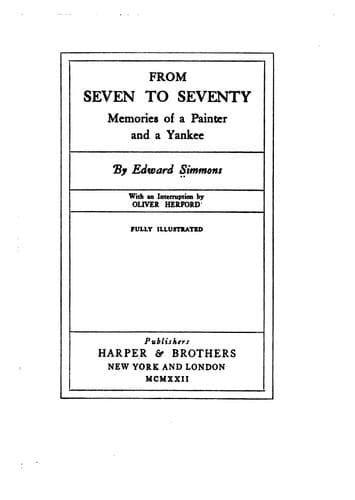
From Seven to Seventy: Memories of a Painter and a YankeeSimmons, Edward
General
From Seven to Seventy: Memories of a Painter and a Yankee
Simmons, Edward
Artists -- Biography
One could hardly tell about the work of Stanford White without including
something of Augustus Saint-Gaudens, for America is richer by many works
of art which are the combination of the genius of these two men.
Saint-Gaudens was the son of a cobbler. I believe that if an exhaustive
history of the clever people of the world were written, it would be
found that a large percentage had been sons of cobblers. As a boy, I
used to be fascinated by a certain cobbler of the town, and while
listening to his words of wisdom I learned to make, entirely with my own
hands, a pair of boots. He was a socialist and, I suppose, an anarchist,
but the joy of life was in his heart and I am sure that fashioning a
beautiful covering for the human foot is as near making a statue as
anything could be.
It was funny to watch the French or the Irish crop out in Gussy. The
French was always on the alert for something beautiful. I remember being
taken by him and several architects up to a place in Cornish. They had
found a charming view. After climbing away up to the top of a
hill—mulleins, granite stones, and not much else in the foreground—I was
told to look off over the landscape and rave. They called it “Too Good
to be True.” I can visualize a farmer, an old resident of the place
(call him Haskins), coming in with the wood which he throws into the
woodbox, saying to his wife:
“There, Mother, I bet you can’t guess where that wood come from.”
“No. Where did it, Jake?”
“From that piece o’ land yer uncle Ezra left yer that Mr. Saint-Gawdeens
and them dudes calls ‘Too Good to be True.’” Great laugh from both.
But every year or two with Gussy the Irish would get on top. A day would
arrive when the work he was doing would disgust him too much. Then he
would fire his assistants, helpers, and everyone out and smash
everything in the studio. He would spend two or three days loafing in
the club and with his friends, then back again, clean it all up, and
begin work, saying, “Now we can get ahead.” The year that he was
forty-nine he came to me, feeling very blue.
“Simmy, I’m out of it. I caught the model we had to-day in class winking
at the fellows when I exclaimed a little too enthusiastically about her
charms. The same thing happened to my master in Italy when I was a
student, and I remember wondering how he could be so silly at his age.”
Then he told me how he had always jumped upon the platforms of the cars
while they were in motion. That day, as he did this, the driver said,
“Peart for yer age, ain’t yer?” In the future he intended to wait until
the car stopped and get on properly.
Public-domain text, read in full here on John Shaqi.
Reviews
Reviews
No reviews yet
Be the first to share your thoughts on this work.
Elsewhere in the archive
Join the Discussion
Join the discussion
Sign in to leave a comment or review.
Sign InorCreate an account