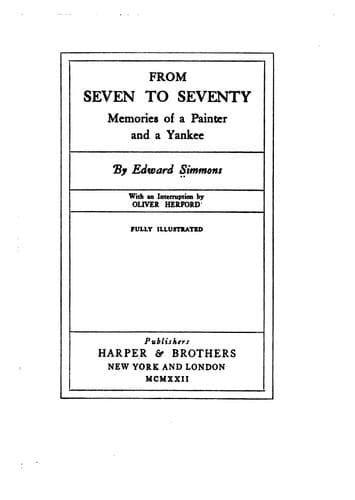
From Seven to Seventy: Memories of a Painter and a YankeeSimmons, Edward
General
From Seven to Seventy: Memories of a Painter and a Yankee
Simmons, Edward
Artists -- Biography
One Sunday in winter the son of the maker of the park was out walking
with his dad, when along came a man with a gun, dragging a big animal.
It was a wolf, and the man took them to the spot where he had shot it.
There was a big patch of blood upon the snow. This is the place where
The Players now stands.
Edwin Booth gave the house to the club, with the condition that he be
allowed to make it his home as long as he lived. It is well known how
the idea started on the yacht of Commodore Benedict and how that nucleus
of clever folk grew into the institution we have to-day. It was not to
be essentially an actors’ club, but a place where the actor could meet
his equals. One must be an artist or a patron of the arts to belong and,
of course, this includes writers, architects, sculptors, and painters.
It is a very beautiful club. Stanford White is responsible for the
architecture and gave his services gratis, as he did for The Lambs. Men
coming from the Old World say that it is the only place in America that
reminds them of home. The tonality of the rooms is like that of the very
old houses of Europe; time has mellowed the walls as it does a bit of
lace or tapestry. One of the ceilings that was a pale robin’s-egg blue
in ’91 is now an exquisite velvet khaki. No man could paint it. Whistler
would give up in despair the idea of even copying it. Like the quality
of the hair and skin of a dear old face, it gives an air of good
breeding, calm, and quiet over all.
The halls and stairways of the house are lined with photographs and
playbills, with, here and there, a painting. Over the fireplace hangs
that admirable portrait of Edwin Booth by Sargent which gives one an
entirely new conception of the actor. On one of the walls is a drawing
by Tom Nast, whom I knew well and loved dearly. It is a political
cartoon which was the original, I am told, of the “Tammany tiger.” Tom
is the illustrator who disposed of the Irish-American question forever
by drawing a banner flying over the Capitol at Washington, on which were
the words, “Erin go unum pluribus bragh.” There are a number of
unusually valuable mezzotints and wood engravings scattered about, and
the biggest collection known to exist, twenty-six portraits in all, of
the painter Naegle. Altogether there are five Sullys, an average Sir
Joshua Reynolds, a remarkably good Gilbert Stuart, a beautiful
Gainsborough in the earlier manner, while on one wall are two small
panels by Benjamin West.
Public-domain text, read in full here on John Shaqi.
Reviews
Reviews
No reviews yet
Be the first to share your thoughts on this work.
Elsewhere in the archive
Join the Discussion
Join the discussion
Sign in to leave a comment or review.
Sign InorCreate an account