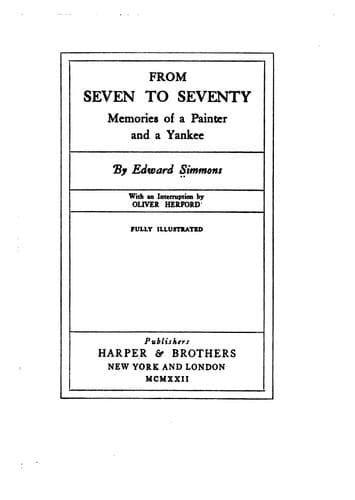
From Seven to Seventy: Memories of a Painter and a YankeeSimmons, Edward
General
From Seven to Seventy: Memories of a Painter and a Yankee
Simmons, Edward
Artists -- Biography
When I look at the mouth in this picture, I am reminded of what
physiognomists say, that it is the indication of our true character more
than any other part of the face. Compare the young and old photographs
of Emerson, Oliver Wendell Holmes, and Booth, and you will see that it
is within the power of anyone (no matter how plain at birth) to have at
least one beautiful feature before he dies. One may not change the
setting of the eyeball—because it is dependent upon bone, which cannot
be altered. The setting of the eye is what gives the beauty. Those of
Christine Nilsson, the singer, appeared on the stage as dark, luminous
patches of velvet, for the socket cast a deep shadow; but when I met her
personally, they were pale blue and ineffectual. It is the same with the
nose.
But the mouth has no bones. It is merely flesh under the control of many
muscles. Surgeons tell me that if one opens the cheek of a man who has
lived an intellectual life, it is surprising how many muscles one finds.
On the other hand, the cheek of an ignorant laborer does not contain
much more than a muscle for chewing, for opening and shutting the mouth,
and for grinning and frowning. The muscles that give irony, humor, and
sadness are not there.
One of the prominent men in America, who has a beautiful mouth, has told
me that when he was a boy his family objected so to it as an unsightly
thing and that for many years he had the habit of covering it with his
hand whenever he expressed himself, for fear of comment. The change has
been within the man himself and the mouth has echoed it.
One may train a plain mouth to express the beauty of the human mind
which controls it. Mr. Emerson had a hole in his face as a boy, not a
mouth. Oliver Wendell Holmes, the plainest man that ever lived, had a
sweet, tender, one might say almost beautiful mouth, before he died. At
any actors’ gathering, one can see a dozen mouths like Booth’s at
twenty-five, but you will hunt a long time before finding the mouth
Booth died with.
The delicacy shown in a study of Edwin Booth’s face was borne out in his
life. He did the most dignified thing in the world, to apologize for an
act of his family against the American nation, by retiring for a period
from public life after the assassination of Lincoln.
Public-domain text, read in full here on John Shaqi.
Reviews
Reviews
No reviews yet
Be the first to share your thoughts on this work.
Elsewhere in the archive
Join the Discussion
Join the discussion
Sign in to leave a comment or review.
Sign InorCreate an account