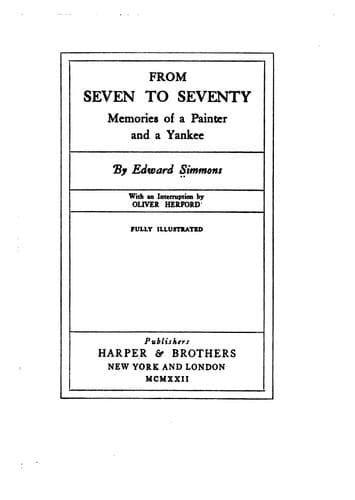
From Seven to Seventy: Memories of a Painter and a YankeeSimmons, Edward
General
From Seven to Seventy: Memories of a Painter and a Yankee
Simmons, Edward
Artists -- Biography
But when he wanted to be serious he made you feel (as Priam says of
Ulysses), “Words, like winter snowflakes, fell from his mouth. Then
might no man compare with Ulysses.” One afternoon a crowd of us were in
the club, drinking and making frivolous talk. Clemens was doing more
than holding his own with the best of us, when suddenly a thought seemed
to strike him. He left for a moment, and when he returned, the
expression of his eyes was changed. He had a book in his hand and he sat
down, saying:
“I will now read you the greatest piece of prose since the days of
Marlowe.”
And then, his nasal twang gone, his voice attaining a beautiful
sonority, he read, as no one else could have done it—the Gettysburg
Speech. It was one of the big moments of my life.
I remember well a comment he made afterward:
“If any one of you men ever have a class in English,” he said, “give
them this. Let them try to put an adverb after the word _here_. No one
but Lincoln could have thought of using, ‘That we here _highly_
resolve.’ No! No! No one!”
The last time I saw Mark Twain was at a luncheon at Delmonico’s, given
by one of my friends in honor of a British army attaché. I got there
rather early and my host was worried for fear his guest of honor would
be disappointed in Mr. Clemens. He was getting old and did not perform
readily. I said:
“Will you leave it to me? I’ll make him show off; but you must promise
not to be surprised at anything and to back me up, however foolish I may
act.”
He promised.
I went to the butler and asked him to see that there was a man behind
Mr. Clemens to refill his glass as soon as he took a sip. He did not
drink much in those days, so it was important he must not be given a
chance to refuse. Before the chill of the beginning of the lunch had
passed off, I rose and said to my host:
“I want to tell a story.”
Derision from the others: “He talks all the time!” “Shut up!” They even
threw bread at me to keep me quiet. But I insisted in a silly way, as if
I were drunk, and my host backed me up. Then I began to tell one of Mr.
Clemens’s pet stories in such a manner that no one but he would
recognize it. I mixed it all up and finally missed the point altogether,
sitting down with a fatuous grin.
He couldn’t stand it. His face grew red, he bristled and glared, reached
for his cocktail, downed it, and rose.
“That was a good story,” he said, indignantly, “but _he_ can’t tell it.
This is the way it should go.” And he told it in his inimitable way.
After that nothing could stop him. He was witty, clever, and the life of
the lunch. The old Clemens girded on his armor and went out again
arrayed for battle; but I often wonder if he went to his grave thinking
I was as much of an ass as I appeared that day.
Chapter XV: Paint and Painters
Public-domain text, read in full here on John Shaqi.
Reviews
Reviews
No reviews yet
Be the first to share your thoughts on this work.
Elsewhere in the archive
Join the Discussion
Join the discussion
Sign in to leave a comment or review.
Sign InorCreate an account