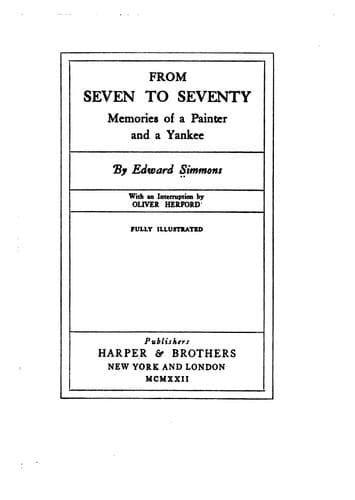
From Seven to Seventy: Memories of a Painter and a YankeeSimmons, Edward
General
From Seven to Seventy: Memories of a Painter and a Yankee
Simmons, Edward
Artists -- Biography
All this is hard for the artist whose only desire is to catch and keep
some of the beauty that he finds about him, and if he is forced to
depend upon the sale of these dreams to provide him with bread and
butter, he is quite liable to starvation or cynicism. The ordinary
person cannot possibly realize how close to the wind an idealist often
gets. To say that you are “broke” means nothing to the business man. I
once heard one of them tell a painter friend of mine that it was all
wrong for him to owe his washerwoman, that he should do, as all
practical folk did, go down and hypothecate a bond! It is unethical for
an artist (as it is for a professional man) to go into the courts or to
advertise. He must not ask for work or show that he is hard up in any
way, and, like the stage folk, he must hold his work at a high price.
The distance between the price of a work of art and the money one can
obtain for it is a long road, however. I was astonished to read in a
newspaper, not long ago, that a picture of mine, bought by a well-known
millionaire, was appraised, at his death, for exactly ten times the
amount I had received for it not more than ten years before.
If a man dies or goes crazy—so that the source of supply is definitely
cut off—his work immediately jumps in value. I often think of John
Twachtman, struggling along without any particular recognition, selling
his pictures for little or nothing, and almost bankrupt when he died.
His brother painters knew the value of his work and resolved to make the
public see it. The dealers fought shy of it, as he had not been a
popular seller when alive. Choosing the right week in February and the
proper gallery (the American Art Association) such men as Thomas Dewing
and Alden Weir, who commanded a position in the fine arts in this
country, were joined by one of the unusual people in America—a man with
a strange combination of business ability, overwhelmed by a love of
beauty—Thomas W. Clarke. Twachtman’s pictures, of which there were a
great many, were properly placed before the public, with the result that
his bills were paid and a substantial sum realized for his widow. A
number of his best canvases were reserved so that Mrs. Twachtman might
have them for a nest egg.
Public-domain text, read in full here on John Shaqi.
Reviews
Reviews
No reviews yet
Be the first to share your thoughts on this work.
Elsewhere in the archive
Join the Discussion
Join the discussion
Sign in to leave a comment or review.
Sign InorCreate an account