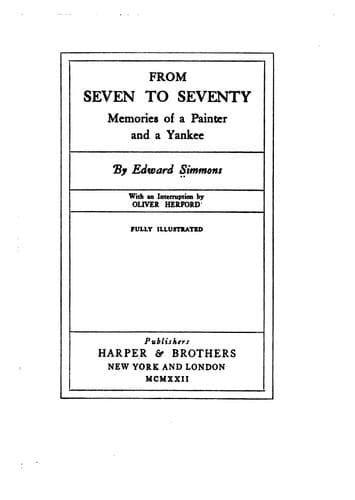
From Seven to Seventy: Memories of a Painter and a YankeeSimmons, Edward
General
From Seven to Seventy: Memories of a Painter and a Yankee
Simmons, Edward
Artists -- Biography
And this man’s productions go all over the United States, in many
obscure and out-of-the-way places. They are the only specimens (besides
those atrocities—the Sunday colored supplements) that the people have
upon which to form an artistic taste.
Then there is that tendency to “follow de crowd.” We all have it, and in
attempting to get away from it resort to the other extreme, resulting in
so-called Cubism and Futurism, etc. We are like the sheep I saw on
Scott’s ranch in California. Although for two generations the rail fence
leading from one field to another had not existed, these creatures still
skipped in the empty air, just as did their grandfathers long ago. We
are the same, else why do sculptors make statues in marble when there is
an abundance of wonderful jasper in this country? Tradition and the
Greeks say so. I have no quarrel with the man who goes to the other
extreme, provided he first learns what the world has found out, up to
his time, about his art, and then chooses to differ. He may possibly add
something. But if he insists upon being ignorant, it is like the
Sultan’s order to his general to burn the library at Alexandria. “If the
books agree with the Koran, they are needless; if they disagree, they
are wicked. Burn them.”
We speak of Realism and Idealism—it seems to me that we just go around
in circles and all such discussion is futile. First, we dig with our
noses, like the ground hog, producing Realism; then we gradually climb
up, going through all the stages of Idealism, Super-idealism,
Æstheticism, and Euphuism. Then bang! we drop back again to the ground
hog and dig for the truth.
Kenyon Cox gave us the best idea of this question that I know of. He
said (to paraphrase): “Every honest worker is striving to realize his
ideal. He maintains, if he succeeds, that he has produced Realism, but
it is not the way we outsiders see it. To us it is Idealism.”
Hawkins told me about following Corot in the fields when he was
painting. One day when the master had made a particularly beautiful
landscape, with cows browsing in the foreground, Hawkins objected to the
fact that Corot had painted in a pond when there was really none in
sight.
“My cows will be in my picture for a thousand years,” he answered, “and
I put in the pond to give them some water.”
In 1913, the order for the Panama Pacific International Exposition at
San Francisco came along, and in order to free my mind of old ties and
get a new point of view, I took a boat to the Barbadoes, before starting
my compositions.
Public-domain text, read in full here on John Shaqi.
Reviews
Reviews
No reviews yet
Be the first to share your thoughts on this work.
Elsewhere in the archive
Join the Discussion
Join the discussion
Sign in to leave a comment or review.
Sign InorCreate an account