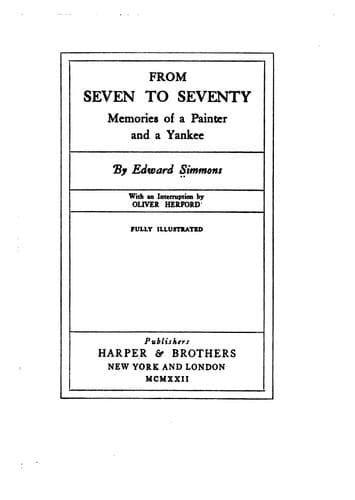
From Seven to Seventy: Memories of a Painter and a YankeeSimmons, Edward
General
From Seven to Seventy: Memories of a Painter and a Yankee
Simmons, Edward
Artists -- Biography
The rooms were built around a central court, very much like a patio.
Horses and carriages drove right in here, depositing guests almost at
the office desk. The furniture for all the rooms was made of solid
mahogany which Mr. Ralston brought all the way from South America in a
big white fleet sent down for the purpose. Nothing more completely
Western or completely comfortable could be imagined. If you stopped at
the Palace Hotel, you were certain to get the feeling that you were
somebody’s personal guest and that that somebody had taken a great deal
of trouble for your ease and enjoyment.
In his own home at Belmont, Mr. Ralston was an extravagant host. The
immense house was always crowded with guests, and from a specially
constructed gallery he looked down (like an Emperor of Rome) upon these
numbers of people, each one amusing himself according to his own
personal desire. But emperors fall, and there are always people jealous
of a dictator, no matter how just he may be. Ralston lived for others
and consequently trusted others; therefore, the blow must have been
harder to bear when it fell.
I saw him the day he was asked to resign from the presidency of the
California Bank. It was right after he had left the board of directors.
He did not act in any way unusual, but came out of the building, went
straight to his carriage, and drove away. That was in the morning. The
evening papers had the account of his suicide. He had gone out to North
Beach to have his daily swim, and, contrary to his usual habit, left his
watch and valuables in the life saver’s hands, waded into the water, and
was gone.
One could hardly pass over the dreamers of the West without telling of
the greatest of them all—the Emperor Norton. His was a vision worth
having, for he believed himself the deposed ruler of the vast kingdom of
the United States. Foully ousted from his throne, he was only biding the
time when he would come into what was rightfully his. I suppose “the few
faithful subjects,” who stuck to him were the citizens of San Francisco.
At any rate, they furnished him with a living and the few luxuries he
deemed necessary in his exile. They called him a “natural,” but I often
suspected him of being more clever than they knew.
The Emperor looked very much like General Grant, perhaps because of his
bushy beard and long blue army coat. In his top hat he wore a feather
and elaborate gold epaulets on his shoulders, while across his breast
were rows and rows of medals. He was in no way shabby, and, in _spite_
of his costume, gave the impression of mighty dignity. No one laughed at
him, no one interfered with him, and he went his way, receiving
everything he wanted without paying a cent. Charity? Not at all. He took
it as his right. The street cars belonged to him; therefore, he rode for
nothing.
Public-domain text, read in full here on John Shaqi.
Reviews
Reviews
No reviews yet
Be the first to share your thoughts on this work.
Join the Discussion
Join the discussion
Sign in to leave a comment or review.
Sign InorCreate an account