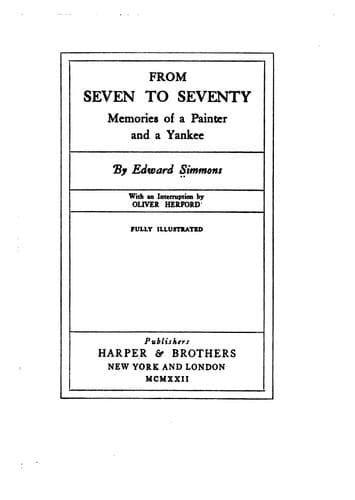
From Seven to Seventy: Memories of a Painter and a YankeeSimmons, Edward
General
From Seven to Seventy: Memories of a Painter and a Yankee
Simmons, Edward
Artists -- Biography
Having no funds, I walked to my next stop, which was the United States
Salmon Hatchery on the McCloud River. Livingston Stone, who had been
sent out by Baird of the Smithsonian Institution to run the place, was a
retired parson, but very wisely shed his religious ideas before going
west. I’ll never forget when he let me into the secret of the drink he
gave the workmen every hot summer afternoon. A huge washtub full of cold
water into which was put a quart of raspberry shrub and a quart of pure
alcohol. The men did not realize what they were drinking, as it looked
like pink circus lemonade. Mr. Stone knew the government would not O. K.
large bills for rum, but pure alcohol might be used for anything.
To anyone who has not seen a fish hatchery it is a fascinating place.
The big fish came up into the McCloud River to spawn, and from here most
of the rivers of the world were supplied with their eggs. Exhausted from
the trip up, for they never touch food from the time they leave their
homes, an expert can simply reach down and catch them with his hand. The
eggs of the female are pressed out into pans where the milt of the males
is squirted over them, fertilizing them in water—the unimpregnated ones
being sorted out. They are then ready for packing in cracked ice and
swamp moss, some traveling as far as New Zealand. Nature hatches out
twenty-five per cent of her salmon eggs, but it was considered a failure
if we did not produce ninety-eight per cent in living fish. If we could
only do the same with the human race, we could make perfect children and
just the number the Government needed.
The Indians were of the tribe of Wintoon, called “Digger.” They were
dirty and lazy, and, although some of them had been educated in the
public schools, they very soon lapsed into their original state. Even
then it was against the law to sell them whisky, but I have seen a young
Indian boy take a quart, sit down in the sand and knock off the head
against a rock, clap the hole to his mouth, and drink the whole thing
without stopping. Needless to say, he fell over as if stunned with a
blow, and would have rolled into the river if he had not been rescued.
The Indian women were certainly not attractive. In the winter they wore
thickness upon thickness of old sacks and rags wound around themselves,
principally their legs, and these never came off until they rotted or
the summer heat drove them to take knives and cut the dirt-caked and
incrusted stuff away. Along toward spring they were objects to keep away
from, but in summer they were more bearable, as they bathed in the river
almost daily. I remember venturing into their particular swimming pool
one day and being taken by the arms and legs and almost drowned, they
thinking it a joke. I believe the Indians were the originators of the
Turkish bath in America. They had a religious ceremony very much like it
which was about as good a way of getting rid of the unfit as I know of.
Public-domain text, read in full here on John Shaqi.
Reviews
Reviews
No reviews yet
Be the first to share your thoughts on this work.
Join the Discussion
Join the discussion
Sign in to leave a comment or review.
Sign InorCreate an account