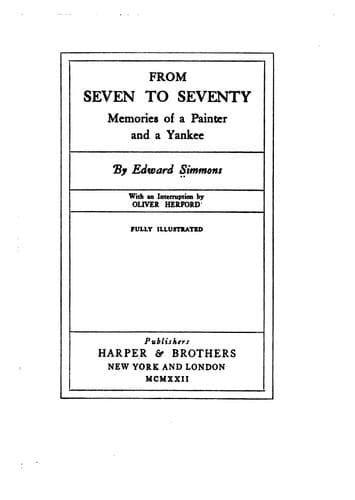
From Seven to Seventy: Memories of a Painter and a YankeeSimmons, Edward
General
From Seven to Seventy: Memories of a Painter and a Yankee
Simmons, Edward
Artists -- Biography
We were a motley crowd—all nationalities. There was the usual “bad man
from Texas.” He talked loud, swaggered, and bluffed, and kept the car in
a general uproar. His food for the trip—as far as we could see—consisted
of several feet of bologna sausage which he had hung from the rack above
his seat. When he deemed it time to eat, he would take out his
vicious-looking knife and “hit it a lick.” However long or short the
slice, he would eat it, saying:
“The Texan only eats what he can get by the might of his right arm.”
Every once in a while his “might” would get beyond all control and he
would knock a hunk of the sausage in among the crowd of poor chattering
Chinamen, frightening them almost out of their senses. Then, to make
matters worse, he would dive for it with his dangerous-looking knife. I
used to argue with him about this action until the bald-headed Chinaman
in the seat in front of me _knew_ I had saved his life. Every morning a
pot of tea, made hot by the stove at the end of the car, was on the
floor beside my bunk.
It was the Texan who told the other men not to play poker with me, as my
hands were “too soft” and I must be a card sharp. When I accosted him
with it he only said, “Well, how _did_ you get those hands?” and was
much amused when I answered, “Painting pictures.”
We never left the train that we did not encounter some strange
adventure. At one station, in a shed for horses, we saw the body of a
negro with sixteen bullet holes in it, a sight that would have been
carefully guarded from the eyes of first-class passengers. At Ogden City
we bribed the trainman to tell us that we would have several hours to
spare. There was a camp of seventy-five tramps on the border of the
lake, and their antics had been terrorizing the citizens. These men of
the road accepted us as bosom companions, told us stories, and finally
fed us a wonderful dinner of chicken and all sorts of delicacies,
cordially inviting us to join them permanently.
Instead of being a bore, the trip was one of the most delightful I ever
made and, except for one small aftermath, marked the closing of a
definite chapter in my life. I had been back only a short time when I
was walking along Howard Street in Boston, my thoughts everywhere but
out West. Noticing a crowd in front of a house, I drew up to see the
excitement. It was nothing unusual for those days—a gang of toughs were
wrecking a Chinese laundry. Standing at the door, uttering most horrible
sounds and brandishing an ax in his hand, was an old Chinaman. Just then
he saw me, stopped yelling, dropped his ax, and, to the astonishment of
all, fell on my neck. All Chinamen looked alike to me, but there could
be no doubt about it—it was my friend of the emigrant train. Of course I
appealed to the police and the toughs were dispersed; but I had an awful
time explaining to this frightened Oriental that I was not his savior.
Public-domain text, read in full here on John Shaqi.
Reviews
Reviews
No reviews yet
Be the first to share your thoughts on this work.
Elsewhere in the archive
Join the Discussion
Join the discussion
Sign in to leave a comment or review.
Sign InorCreate an account