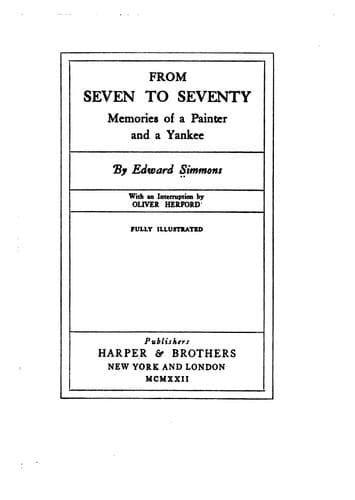
From Seven to Seventy: Memories of a Painter and a YankeeSimmons, Edward
General
From Seven to Seventy: Memories of a Painter and a Yankee
Simmons, Edward
Artists -- Biography
I never forgot this, for the speaker was De Monvel himself, and he
certainly did scoop the idea.
One who always attracted a crowd was Rosa Bonheur—she who was made
famous and wealthy by American dollars. She looked like a small,
undersized man, wore gray trousers, Prince Albert coat and top hat to
these affairs. Her face was gray white and wizened, and she
gesticulated, speaking in a high, squeaky voice. I have never seen
anyone who gave a more perfect impression of a eunuch.
The Salon was not all fun; there were many tragedies. One day I called
on my friend Renouf, a first-medalist, who was painting a decoration in
the Palais de l’Industrie. The Salon had been closed a month, but there
were hundreds of rejected canvases standing outside that had never been
called for. Some were not even framed. He hauled out several pathetic
attempts; then, coming upon one, said:
“Did you ever hear of a painter named G——? He has just been locked up;
crazy.”
The picture was about six by ten feet, had no frame, but it was signed
in large letters. It was a scene of a long corridor, with two barred
windows on the side and a man crouched against the wall, with the most
maniacal expression on his face. I never have forgotten the horror; he
must have painted it when he was going crazy. I often think of poor De
Maupassant, whose extreme intelligence warned him of approaching
insanity and who, having a gun, desired to take his life. Of course, the
gracious Christians surrounding him preferred his earthly sufferings to
his heavenly happiness, and so prevented him from doing it.
Ten years after a man of prominence in the artistic world dies the
French give a showing of his work. This places him historically as an
artist. Some of his pictures are purchased by the government and, after
this exhibition, if the authorities deem him great enough, pictures by
him are moved to the Louvre. I remember the ten-year show of Courbet. He
had been an anarchist, also one of the leaders in the Commune, and his
work was considered frightfully “modern.” He was the brutal sort of
painter that our present-day young men try to emulate, but, though he
died many years ago, Courbet was a far abler painter than any man now
alive in America.
Of course, this realism of execution brought forth much criticism from
the members of the so-called old-school artists, and among the leaders
in denouncing Courbet (while alive) was that classic authority, Tony
Fleury. He considered this type of art worthless and all wrong and, if I
mistake not, expressed his opinion of the modern man in the newspapers.
Public-domain text, read in full here on John Shaqi.
Reviews
Reviews
No reviews yet
Be the first to share your thoughts on this work.
Elsewhere in the archive
Join the Discussion
Join the discussion
Sign in to leave a comment or review.
Sign InorCreate an account