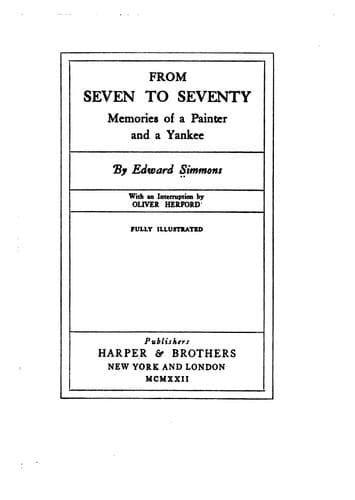
From Seven to Seventy: Memories of a Painter and a YankeeSimmons, Edward
General
From Seven to Seventy: Memories of a Painter and a Yankee
Simmons, Edward
Artists -- Biography
Pouchet was an intimate friend of Alfred de Musset and told me much
about him. The poet had many fads inherited from the days of swords,
pistols, snuff, and powdered hair. For instance, he would under no
circumstances accept copper money; in fact, he would not touch the metal
in any form. Toward the end of Musset’s life he frequented a certain
café in Paris—used it as a club. He would go there to write his letters,
read his paper, etc., and with him would be a quiet man in plain
clothing whom you would not notice. At a certain time in the evening he
would make a gesture to the waiter, who would serve him with two
carafons—one of brandy and one of absinthe. He would pour them together
in one glass and, looking at them, take out of his buttonhole his button
of General of the Legion of Honor, and put it in his waistcoat. He would
then down the mixture at once; the quiet man would approach and take him
to his carriage. No one but a Frenchman could have done this; he would
not get drunk as a member of the Legion!
Sitting one time with Pouchet and a well-known authoress, discussing
sex, he said:
“You make a mistake, mademoiselle, there are four sexes. Male—Mr.
Simmons; female—your charming self; neuter”—pointing to a stuffy judge
way down the room; “and potentially male or female. This sex can be
recognized by the human hair. It is long in the men and short in the
women. Let us call it the professorial sex.” Women’s rights, divorce
laws, etc., were then unknown in France, so this was quite an advanced
idea.
The last time I saw Pouchet was in New York. He was about sixty-three
years old. We were lunching at the Players and I asked:
“What brings you to America?”
“To study the question of tonsils.”
“Are American tonsils different from European?” I asked.
“Oh no! We are interested in the tonsils of other mammals—of the whale.”
Just before he went back to France I asked him what conclusion his
investigation had brought forth.
“A matter of great importance,” he answered. “The fact that the tonsil
is of no importance.”
I have since heard this disputed, but I thought it very interesting that
these learned men should work so long and so hard for such a result.
The British artists passed by Concarneau and went on to Pont Aven, where
there were ready-made landscapes for the water-colorists. Truth to tell,
they were frightened by the bigness of the coast and left it to the
French and Americans, who formed a very happy crowd, all living at the
Hotel des Voyageurs. There was Thaddeus Jones, who has since painted a
portrait of the Pope; Alexander Harrison, the famous marine painter;
Frank Chadwick; Howard Russell Butler; M. Brion; Emile Renouf; Paul
Dubois, the sculptor; and Bastien Le Page. Bastien was the first in
importance in the Concarneau older set, being almost the father of the
Realistic movement. He was a quiet, well-bred person, swift at repartee,
and could write as corking a letter to the press as Whistler.
Public-domain text, read in full here on John Shaqi.
Reviews
Reviews
No reviews yet
Be the first to share your thoughts on this work.
Elsewhere in the archive
Join the Discussion
Join the discussion
Sign in to leave a comment or review.
Sign InorCreate an account