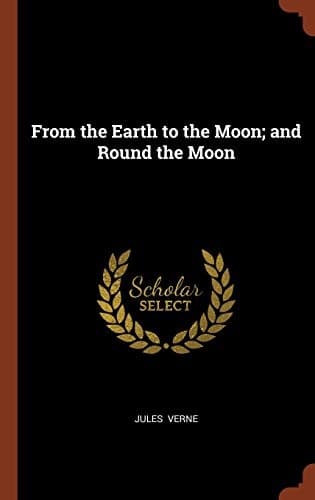
From the Earth to the moon; and, round the moonVerne, Jules
Science
From the Earth to the moon; and, round the moon
Verne, Jules
Manned space flight -- Fiction; Moon -- Fiction; Science fiction; Space flight to the moon -- Fiction; Space ships -- Fiction
“What astonishes me,” said Nicholl, “is that the specific weight of the
body, which is certainly less than that of the projectile, allows it to
keep so perfectly on a level with it.”
“Nicholl,” replied Barbicane, after a moment’s reflection, “I do not
know what the object it, but I do know why it maintains our level.”
“And why?”
“Because we are floating in space, my dear captain, and in space bodies
fall or move (which is the same thing) with equal speed whatever be
their weight or form; it is the air, which by its resistance creates
these differences in weight. When you create a vacuum in a tube, the
objects you send through it, grains of dust or grains of lead, fall
with the same rapidity. Here in space is the same cause and the same
effect.”
“Just so,” said Nicholl, “and everything we throw out of the projectile
will accompany it until it reaches the moon.”
“Ah! fools that we are!” exclaimed Michel.
“Why that expletive?” asked Barbicane.
“Because we might have filled the projectile with useful objects,
books, instruments, tools, etc. We could have thrown them all out, and
all would have followed in our train. But happy thought! Why cannot we
walk outside like the meteor? Why cannot we launch into space through
the scuttle? What enjoyment it would be to feel oneself thus suspended
in ether, more favored than the birds who must use their wings to keep
themselves up!”
“Granted,” said Barbicane, “but how to breathe?”
“Hang the air, to fail so inopportunely!”
“But if it did not fail, Michel, your density being less than that of
the projectile, you would soon be left behind.”
“Then we must remain in our car?”
“We must!”
“Ah!” exclaimed Michel, in a load voice.
“What is the matter,” asked Nicholl.
“I know, I guess, what this pretended meteor is! It is no asteroid
which is accompanying us! It is not a piece of a planet.”
“What is it then?” asked Barbicane.
“It is our unfortunate dog! It is Diana’s husband!”
Indeed, this deformed, unrecognizable object, reduced to nothing, was
the body of Satellite, flattened like a bagpipe without wind, and ever
mounting, mounting!
CHAPTER VII.
A MOMENT OF INTOXICATION
Thus a phenomenon, curious but explicable, was happening under these
strange conditions.
Every object thrown from the projectile would follow the same course
and never stop until it did. There was a subject for conversation which
the whole evening could not exhaust.
Besides, the excitement of the three travelers increased as they drew
near the end of their journey. They expected unforseen incidents, and
new phenomena; and nothing would have astonished them in the frame of
mind they then were in. Their overexcited imagination went faster than
the projectile, whose speed was evidently diminishing, though
insensibly to themselves. But the moon grew larger to their eyes, and
they fancied if they stretched out their hands they could seize it.
Public-domain text, read in full here on John Shaqi.
Reviews
Reviews
No reviews yet
Be the first to share your thoughts on this work.
Elsewhere in the archive
Join the Discussion
Join the discussion
Sign in to leave a comment or review.
Sign InorCreate an account