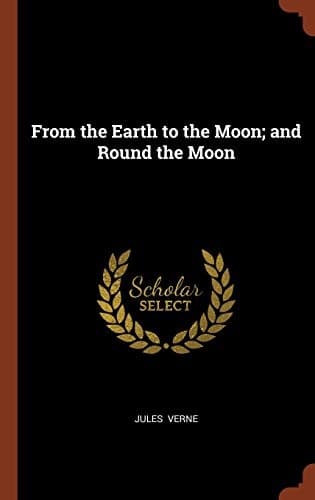
From the Earth to the moon; and, round the moonVerne, Jules
Science
From the Earth to the moon; and, round the moon
Verne, Jules
Manned space flight -- Fiction; Moon -- Fiction; Science fiction; Space flight to the moon -- Fiction; Space ships -- Fiction
Without imparting his uneasiness to his companions, Barbicane contented
himself with constantly observing the moon, in order to see whether the
course of the projectile would not be altered; for the situation would
have been terrible if it failed in its aim, and being carried beyond
the disc should be launched into interplanetary space. At that moment,
the moon, instead of appearing flat like a disc, showed its convexity.
If the sun’s rays had struck it obliquely, the shadow thrown would have
brought out the high mountains, which would have been clearly detached.
The eye might have gazed into the crater’s gaping abysses, and followed
the capricious fissures which wound through the immense plains. But all
relief was as yet leveled in intense brilliancy. They could scarcely
distinguish those large spots which give the moon the appearance of a
human face.
“Face, indeed!” said Michel Ardan; “but I am sorry for the amiable
sister of Apollo. A very pitted face!”
But the travelers, now so near the end, were incessantly observing this
new world. They imagined themselves walking through its unknown
countries, climbing its highest peaks, descending into its lowest
depths. Here and there they fancied they saw vast seas, scarcely kept
together under so rarefied an atmosphere, and water-courses emptying
the mountain tributaries. Leaning over the abyss, they hoped to catch
some sounds from that orb forever mute in the solitude of space. That
last day left them.
They took down the most trifling details. A vague uneasiness took
possession of them as they neared the end. This uneasiness would have
been doubled had they felt how their speed had decreased. It would have
seemed to them quite insufficient to carry them to the end. It was
because the projectile then “weighed” almost nothing. Its weight was
ever decreasing, and would be entirely annihilated on that line where
the lunar and terrestrial attractions would neutralize each other.
But in spite of his preoccupation, Michel Ardan did not forget to
prepare the morning repast with his accustomed punctuality. They ate
with a good appetite. Nothing was so excellent as the soup liquefied by
the heat of the gas; nothing better than the preserved meat. Some
glasses of good French wine crowned the repast, causing Michel Ardan to
remark that the lunar vines, warmed by that ardent sun, ought to
distill even more generous wines; that is, if they existed. In any
case, the far-seeing Frenchman had taken care not to forget in his
collection some precious cuttings of the Medoc and Cote d’Or, upon
which he founded his hopes.
Reiset and Regnaut’s apparatus worked with great regularity. Not an
atom of carbonic acid resisted the potash; and as to the oxygen,
Captain Nicholl said “it was of the first quality.” The little watery
vapor enclosed in the projectile mixing with the air tempered the
dryness; and many apartments in London, Paris, or New York, and many
theaters, were certainly not in such a healthy condition.
Public-domain text, read in full here on John Shaqi.
Reviews
Reviews
No reviews yet
Be the first to share your thoughts on this work.
Elsewhere in the archive
Join the Discussion
Join the discussion
Sign in to leave a comment or review.
Sign InorCreate an account