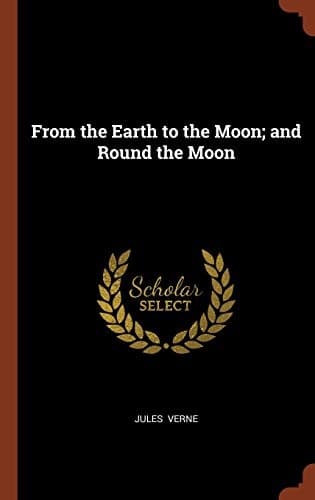
From the Earth to the moon; and, round the moonVerne, Jules
Science
From the Earth to the moon; and, round the moon
Verne, Jules
Manned space flight -- Fiction; Moon -- Fiction; Science fiction; Space flight to the moon -- Fiction; Space ships -- Fiction
At half-past two in the morning, the projectile was over the thirteenth
lunar parallel and at the effective distance of five hundred miles,
reduced by the glasses to five. It still seemed impossible, however,
that it could ever touch any part of the disc. Its motive speed,
comparatively so moderate, was inexplicable to President Barbicane. At
that distance from the moon it must have been considerable, to enable
it to bear up against her attraction. Here was a phenomenon the cause
of which escaped them again. Besides, time failed them to investigate
the cause. All lunar relief was defiling under the eyes of the
travelers, and they would not lose a single detail.
Under the glasses the disc appeared at the distance of five miles. What
would an aeronaut, borne to this distance from the earth, distinguish
on its surface? We cannot say, since the greatest ascension has not
been more than 25,000 feet.
This, however, is an exact description of what Barbicane and his
companions saw at this height. Large patches of different colors
appeared on the disc. Selenographers are not agreed upon the nature of
these colors. There are several, and rather vividly marked. Julius
Schmidt pretends that, if the terrestrial oceans were dried up, a
Selenite observer could not distinguish on the globe a greater
diversity of shades between the oceans and the continental plains than
those on the moon present to a terrestrial observer. According to him,
the color common to the vast plains known by the name of “seas” is a
dark gray mixed with green and brown. Some of the large craters present
the same appearance. Barbicane knew this opinion of the German
selenographer, an opinion shared by Boeer and Moedler. Observation has
proved that right was on their side, and not on that of some
astronomers who admit the existence of only gray on the moon’s surface.
In some parts green was very distinct, such as springs, according to
Julius Schmidt, from the seas of “Serenity and Humors.” Barbicane also
noticed large craters, without any interior cones, which shed a bluish
tint similar to the reflection of a sheet of steel freshly polished.
These colors belonged really to the lunar disc, and did not result, as
some astronomers say, either from the imperfection in the objective of
the glasses or from the interposition of the terrestrial atmosphere.
Not a doubt existed in Barbicane’s mind with regard to it, as he
observed it through space, and so could not commit any optical error.
He considered the establishment of this fact as an acquisition to
science. Now, were these shades of green, belonging to tropical
vegetation, kept up by a low dense atmosphere? He could not yet say.
Farther on, he noticed a reddish tint, quite defined. The same shade
had before been observed at the bottom of an isolated enclosure, known
by the name of Lichtenburg’s circle, which is situated near the
Hercynian mountains, on the borders of the moon; but they could not
tell the nature of it.
Public-domain text, read in full here on John Shaqi.
Reviews
Reviews
No reviews yet
Be the first to share your thoughts on this work.
Elsewhere in the archive
Join the Discussion
Join the discussion
Sign in to leave a comment or review.
Sign InorCreate an account