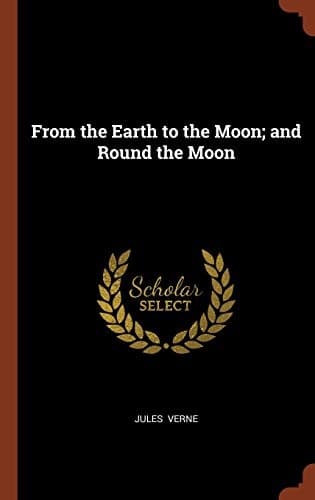
From the Earth to the moon; and, round the moonVerne, Jules
Science
From the Earth to the moon; and, round the moon
Verne, Jules
Manned space flight -- Fiction; Moon -- Fiction; Science fiction; Space flight to the moon -- Fiction; Space ships -- Fiction
“Let us prepare a thermometer,” said Barbicane.
We may imagine that an ordinary thermometer would afford no result
under the circumstances in which this instrument was to be exposed. The
mercury would have been frozen in its ball, as below 42° Fahrenheit
below zero it is no longer liquid. But Barbicane had furnished himself
with a spirit thermometer on Wafferdin’s system, which gives the minima
of excessively low temperatures.
Before beginning the experiment, this instrument was compared with an
ordinary one, and then Barbicane prepared to use it.
“How shall we set about it?” asked Nicholl.
“Nothing is easier,” replied Michel Ardan, who was never at a loss. “We
open the scuttle rapidly; throw out the instrument; it follows the
projectile with exemplary docility; and a quarter of an hour after,
draw it in.”
“With the hand?” asked Barbicane.
“With the hand,” replied Michel.
“Well, then, my friend, do not expose yourself,” answered Barbicane,
“for the hand that you draw in again will be nothing but a stump frozen
and deformed by the frightful cold.”
“Really!”
“You will feel as if you had had a terrible burn, like that of iron at
a white heat; for whether the heat leaves our bodies briskly or enters
briskly, it is exactly the same thing. Besides, I am not at all certain
that the objects we have thrown out are still following us.”
“Why not?” asked Nicholl.
“Because, if we are passing through an atmosphere of the slightest
density, these objects will be retarded. Again, the darkness prevents
our seeing if they still float around us. But in order not to expose
ourselves to the loss of our thermometer, we will fasten it, and we can
then more easily pull it back again.”
Barbicane’s advice was followed. Through the scuttle rapidly opened,
Nicholl threw out the instrument, which was held by a short cord, so
that it might be more easily drawn up. The scuttle had not been opened
more than a second, but that second had sufficed to let in a most
intense cold.
“The devil!” exclaimed Michel Ardan, “it is cold enough to freeze a
white bear.”
Barbicane waited until half an hour had elapsed, which was more than
time enough to allow the instrument to fall to the level of the
surrounding temperature. Then it was rapidly pulled in.
Barbicane calculated the quantity of spirits of wine overflowed into
the little vial soldered to the lower part of the instrument, and said:
“A hundred and forty degrees Centigrade[4] below zero!”
[4] 218 degrees Fahrenheit below zero.
M. Pouillet was right and Fourier wrong. That was the undoubted
temperature of the starry space. Such is, perhaps, that of the lunar
continents, when the orb of night has lost by radiation all the heat
which fifteen days of sun have poured into her.
CHAPTER XV.
HYPERBOLA OR PARABOLA
Public-domain text, read in full here on John Shaqi.
Reviews
Reviews
No reviews yet
Be the first to share your thoughts on this work.
Elsewhere in the archive
Join the Discussion
Join the discussion
Sign in to leave a comment or review.
Sign InorCreate an account