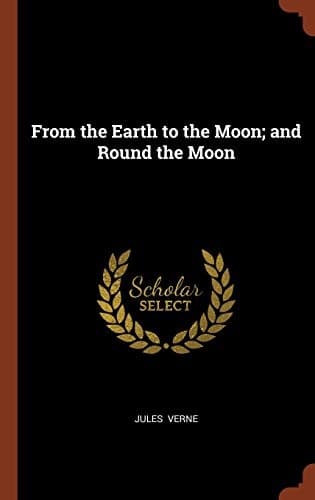
From the Earth to the moon; and, round the moonVerne, Jules
Science
From the Earth to the moon; and, round the moon
Verne, Jules
Manned space flight -- Fiction; Moon -- Fiction; Science fiction; Space flight to the moon -- Fiction; Space ships -- Fiction
“But then,” asked Michel, “I shall be curious to know how our erring
vehicle will act in space?”
“I see but two hypotheses,” replied Barbicane, after some moments’
reflection.
“What are they?”
“The projectile has the choice between two mathematical curves, and it
will follow one or the other according to the speed with which it is
animated, and which at this moment I cannot estimate.”
“Yes,” said Nicholl, “it will follow either a parabola or a hyperbola.”
“Just so,” replied Barbicane. “With a certain speed it will assume the
parabola, and with a greater the hyperbola.”
“I like those grand words,” exclaimed Michel Ardan; “one knows directly
what they mean. And pray what is your parabola, if you please?”
“My friend,” answered the captain, “the parabola is a curve of the
second order, the result of the section of a cone intersected by a
plane parallel to one of the sides.”
“Ah! ah!” said Michel, in a satisfied tone.
“It is very nearly,” continued Nicholl, “the course described by a bomb
launched from a mortar.”
“Perfect! And the hyperbola?”
“The hyperbola, Michel, is a curve of the second order, produced by the
intersection of a conic surface and a plane parallel to its axis, and
constitutes two branches separated one from the other, both tending
indefinitely in the two directions.”
“Is it possible!” exclaimed Michel Ardan in a serious tone, as if they
had told him of some serious event. “What I particularly like in your
definition of the hyperbola (I was going to say hyperblague) is that it
is still more obscure than the word you pretend to define.”
Nicholl and Barbicane cared little for Michel Ardan’s fun. They were
deep in a scientific discussion. What curve would the projectile
follow? was their hobby. One maintained the hyperbola, the other the
parabola. They gave each other reasons bristling with _x_. Their
arguments were couched in language which made Michel jump. The
discussion was hot, and neither would give up his chosen curve to his
adversary.
This scientific dispute lasted so long that it made Michel very
impatient.
“Now, gentlemen cosines, will you cease to throw parabolas and
hyperbolas at each other’s heads? I want to understand the only
interesting question in the whole affair. We shall follow one or the
other of these curves? Good. But where will they lead us to?”
“Nowhere,” replied Nicholl.
“How, nowhere?”
“Evidently,” said Barbicane, “they are open curves, which may be
prolonged indefinitely.”
“Ah, savants!” cried Michel; “and what are either the one or the other
to us from the moment we know that they equally lead us into infinite
space?”
Barbicane and Nicholl could not forbear smiling. They had just been
creating “art for art’s sake.” Never had so idle a question been raised
at such an inopportune moment. The sinister truth remained that,
whether hyperbolically or parabolically borne away, the projectile
would never again meet either the earth or the moon.
Public-domain text, read in full here on John Shaqi.
Reviews
Reviews
No reviews yet
Be the first to share your thoughts on this work.
Elsewhere in the archive
Join the Discussion
Join the discussion
Sign in to leave a comment or review.
Sign InorCreate an account