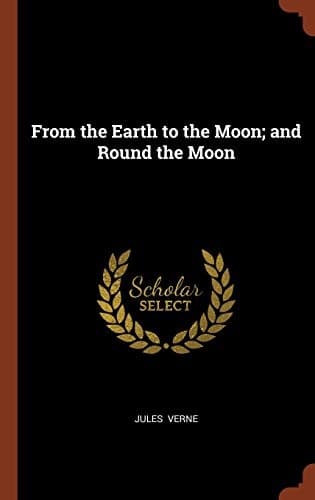
From the Earth to the moon; and, round the moonVerne, Jules
Science
From the Earth to the moon; and, round the moon
Verne, Jules
Manned space flight -- Fiction; Moon -- Fiction; Science fiction; Space flight to the moon -- Fiction; Space ships -- Fiction
Under his eyes ran in all directions luminous furrows, raised at the
edges and concave in the center, some twelve miles, others thirty miles
broad. These brilliant trains extended in some places to within 600
miles of Tycho, and seemed to cover, particularly toward the east, the
northeast and the north, the half of the southern hemisphere. One of
these jets extended as far as the circle of Neander, situated on the
40th meridian. Another, by a slight curve, furrowed the “Sea of
Nectar,” breaking against the chain of Pyrenees, after a circuit of 800
miles. Others, toward the west, covered the “Sea of Clouds” and the
“Sea of Humors” with a luminous network. What was the origin of these
sparkling rays, which shone on the plains as well as on the reliefs, at
whatever height they might be? All started from a common center, the
crater of Tycho. They sprang from him. Herschel attributed their
brilliancy to currents of lava congealed by the cold; an opinion,
however, which has not been generally adopted. Other astronomers have
seen in these inexplicable rays a kind of moraines, rows of erratic
blocks, which had been thrown up at the period of Tycho’s formation.
“And why not?” asked Nicholl of Barbicane, who was relating and
rejecting these different opinions.
“Because the regularity of these luminous lines, and the violence
necessary to carry volcanic matter to such distances, is inexplicable.”
“Eh! by Jove!” replied Michel Ardan, “it seems easy enough to me to
explain the origin of these rays.”
“Indeed?” said Barbicane.
“Indeed,” continued Michel. “It is enough to say that it is a vast
star, similar to that produced by a ball or a stone thrown at a square
of glass!”
“Well!” replied Barbicane, smiling. “And what hand would be powerful
enough to throw a ball to give such a shock as that?”
“The hand is not necessary,” answered Nicholl, not at all confounded;
“and as to the stone, let us suppose it to be a comet.”
“Ah! those much-abused comets!” exclaimed Barbicane. “My brave Michel,
your explanation is not bad; but your comet is useless. The shock which
produced that rent must have some from the inside of the star. A
violent contraction of the lunar crust, while cooling, might suffice to
imprint this gigantic star.”
“A contraction! something like a lunar stomach-ache.” said Michel
Ardan.
“Besides,” added Barbicane, “this opinion is that of an English savant,
Nasmyth, and it seems to me to sufficiently explain the radiation of
these mountains.”
“That Nasmyth was no fool!” replied Michel.
Public-domain text, read in full here on John Shaqi.
Reviews
Reviews
No reviews yet
Be the first to share your thoughts on this work.
Elsewhere in the archive
Join the Discussion
Join the discussion
Sign in to leave a comment or review.
Sign InorCreate an account