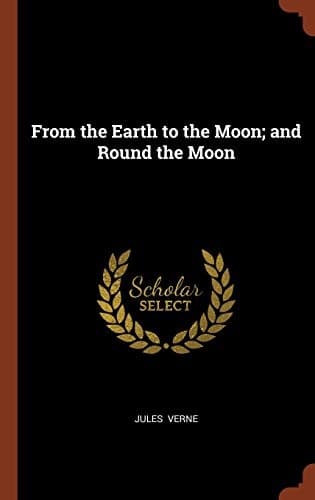
From the Earth to the moon; and, round the moonVerne, Jules
Science
From the Earth to the moon; and, round the moon
Verne, Jules
Manned space flight -- Fiction; Moon -- Fiction; Science fiction; Space flight to the moon -- Fiction; Space ships -- Fiction
“Then we may form our opinion?” said Michel.
“Yes,” replied Nicholl.
“Very well,” continued Michel Ardan, “the Scientific Commission
assembled in the projectile of the Gun Club, after having founded their
argument on facts recently observed, decide unanimously upon the
question of the habitability of the moon—‘_No!_ the moon is not
habitable.’”
This decision was consigned by President Barbicane to his notebook,
where the process of the sitting of the 6th of December may be seen.
“Now,” said Nicholl, “let us attack the second question, an
indispensable complement of the first. I ask the honorable commission,
if the moon is not habitable, has she ever been inhabited, Citizen
Barbicane?”
“My friends,” replied Barbicane, “I did not undertake this journey in
order to form an opinion on the past habitability of our satellite; but
I will add that our personal observations only confirm me in this
opinion. I believe, indeed I affirm, that the moon has been inhabited
by a human race organized like our own; that she has produced animals
anatomically formed like the terrestrial animals: but I add that these
races, human and animal, have had their day, and are now forever
extinct!”
“Then,” asked Michel, “the moon must be older than the earth?”
“No!” said Barbicane decidedly, “but a world which has grown old
quicker, and whose formation and deformation have been more rapid.
Relatively, the organizing force of matter has been much more violent
in the interior of the moon than in the interior of the terrestrial
globe. The actual state of this cracked, twisted, and burst disc
abundantly proves this. The moon and the earth were nothing but gaseous
masses originally. These gases have passed into a liquid state under
different influences, and the solid masses have been formed later. But
most certainly our sphere was still gaseous or liquid, when the moon
was solidified by cooling, and had become habitable.”
“I believe it,” said Nicholl.
“Then,” continued Barbicane, “an atmosphere surrounded it, the waters
contained within this gaseous envelope could not evaporate. Under the
influence of air, water, light, solar heat, and central heat,
vegetation took possession of the continents prepared to receive it,
and certainly life showed itself about this period, for nature does not
expend herself in vain; and a world so wonderfully formed for
habitation must necessarily be inhabited.”
“But,” said Nicholl, “many phenomena inherent in our satellite might
cramp the expansion of the animal and vegetable kingdom. For example,
its days and nights of 354 hours?”
“At the terrestrial poles they last six months,” said Michel.
“An argument of little value, since the poles are not inhabited.”
Public-domain text, read in full here on John Shaqi.
Reviews
Reviews
No reviews yet
Be the first to share your thoughts on this work.
Elsewhere in the archive
Join the Discussion
Join the discussion
Sign in to leave a comment or review.
Sign InorCreate an account