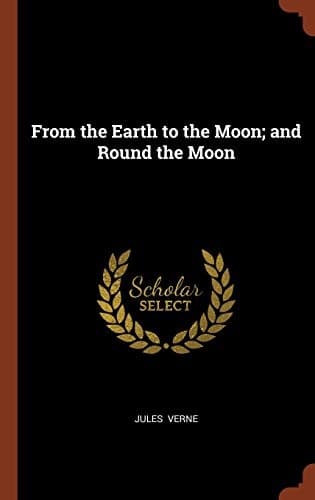
From the Earth to the moon; and, round the moonVerne, Jules
Science
From the Earth to the moon; and, round the moon
Verne, Jules
Manned space flight -- Fiction; Moon -- Fiction; Science fiction; Space flight to the moon -- Fiction; Space ships -- Fiction
would tell him that the scheme of the Divine Redemption, according to
St. Paul, seems to be applicable, not merely to the earth, but to all
the celestial worlds. But, unfortunately, I am neither theologian, nor
chemist, nor naturalist, nor philosopher; therefore, in my absolute
ignorance of the great laws which govern the universe, I confine myself
to saying in reply, ‘I do not know whether the worlds are inhabited or
not: and since I do not know, I am going to see!’”
Whether Michel Ardan’s antagonist hazarded any further arguments or not
it is impossible to say, for the uproarious shouts of the crowd would
not allow any expression of opinion to gain a hearing. On silence being
restored, the triumphant orator contented himself with adding the
following remarks:
“Gentlemen, you will observe that I have but slightly touched upon this
great question. There is another altogether different line of argument
in favor of the habitability of the stars, which I omit for the
present. I only desire to call attention to one point. To those who
maintain that the planets are _not_ inhabited one may reply: You might
be perfectly in the right, if you could only show that the earth is the
best possible world, in spite of what Voltaire has said. She has but
_one_ satellite, while Jupiter, Uranus, Saturn, Neptune have each
several, an advantage by no means to be despised. But that which
renders our own globe so uncomfortable is the inclination of its axis
to the plane of its orbit. Hence the inequality of days and nights;
hence the disagreeable diversity of the seasons. On the surface of our
unhappy spheroid we are always either too hot or too cold; we are
frozen in winter, broiled in summer; it is the planet of rheumatism,
coughs, bronchitis; while on the surface of Jupiter, for example, where
the axis is but slightly inclined, the inhabitants may enjoy uniform
temperatures. It possesses zones of perpetual springs, summers,
autumns, and winters; every Jovian may choose for himself what climate
he likes, and there spend the whole of his life in security from all
variations of temperature. You will, I am sure, readily admit this
superiority of Jupiter over our own planet, to say nothing of his
years, which each equal twelve of ours! Under such auspices and such
marvelous conditions of existence, it appears to me that the
inhabitants of so fortunate a world must be in every respect superior
to ourselves. All we require, in order to attain such perfection, is
the mere trifle of having an axis of rotation less inclined to the
plane of its orbit!”
“Hurrah!” roared an energetic voice, “let us unite our efforts, invent
the necessary machines, and rectify the earth’s axis!”
Public-domain text, read in full here on John Shaqi.
Reviews
Reviews
No reviews yet
Be the first to share your thoughts on this work.
Elsewhere in the archive
Join the Discussion
Join the discussion
Sign in to leave a comment or review.
Sign InorCreate an account