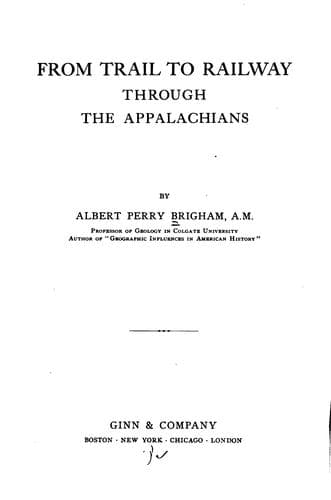
From trail to railway through the AppalachiansBrigham, Albert Perry
History
From trail to railway through the Appalachians
Brigham, Albert Perry
Appalachian Mountains; Atlantic States -- Description and travel; Ohio River Valley -- Description and travel
An early writer says that the Ohio is “by far the noblest river in the
universe.” He writes this in the beginning of a history of Louisville,
a book which was printed in 1819. This in itself shows that Louisville
is one of the old cities of the Ohio valley. It is not so large as
Cincinnati or Pittsburg, but it is the chief city of the great state of
Kentucky.
The old boatmen, finding that the current was rapid at a certain point,
called it the “falls of the Ohio.” A ledge of hard rocks in the bed of
the river caused the rapids and made it no easy task to navigate boats.
Finally a canal was dug by which the rapids might be avoided at low
water.
It was this ledge in the river that started the town and finally
made a city out of Louisville, for boats going in either direction
naturally stopped at the falls. There was another reason, too, as we
shall see when we learn something of the “Wilderness Road,” which
crossed Kentucky from the eastern mountains and came out on the river
at Louisville. Back from the river also lay the rich and fertile Blue
Grass country for which Kentucky is famous.
The canal was ready to take steamboats around the ledge in 1831.
Some of these boats had interesting names, such as the _Enterprise_,
the _Vesuvius_, the _Comet_, the _Volcano_, the _New Orleans_, the
_Cincinnati_, the _Experiment_, the _Rifleman_, and the _Rising States_.
It was a wonderful life on the river, and Louisville got her share of
the gain of it, as she now shares the traffic of the railroads. To-day
she is a rich and beautiful city of two hundred thousand people.
CHAPTER XI
THE GREAT VALLEY
Alexander Spotswood was a famous governor of the colony of Virginia. He
was of Scottish parentage, but he was born in Morocco, where his father
was a surgeon. The lad grew up to serve his country as a soldier, and
was wounded by a cannon ball in a great war then going on in Europe.
In 1710 the king sent him to Virginia to be governor, an office which
he filled for twelve years. The people liked him, though he made some
enemies because he kept his soldierly ways and did not always speak in
gentle phrases. He was a kind, warm-hearted man, nevertheless, loving
his family and friends. His energy, too, was well known, and he was
always ready to further a new scheme.
Because he started the first iron furnaces in America he was called
the “Tubal Cain of Virginia,” Tubal Cain being known in sacred history
as the first of metal workers. Nothing was more important to the
colonists than iron, for they could not always bring tools and kettles
and nails and gun metal from England. The governor showed his practical
ability in other ways. He brought over Germans who knew how to raise
grapes and make wine. He was interested in teaching the Indians, and
at one time he sent out ships and caught “Blackbeard,” who, with his
fellow-pirates, was prowling about the coast. When the young Benjamin
Franklin, in Boston, heard of the capture he wrote a poem about it.
Public-domain text, read in full here on John Shaqi.
Reviews
Reviews
No reviews yet
Be the first to share your thoughts on this work.
Elsewhere in the archive
Join the Discussion
Join the discussion
Sign in to leave a comment or review.
Sign InorCreate an account