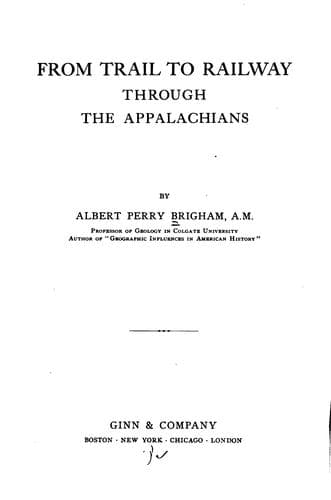
From trail to railway through the AppalachiansBrigham, Albert Perry
History
From trail to railway through the Appalachians
Brigham, Albert Perry
Appalachian Mountains; Atlantic States -- Description and travel; Ohio River Valley -- Description and travel
At one time they were taken by Indians, who plundered their camp and
stole all their furs. Most of the party were discouraged and went back
to the settlements, but Boone and one companion were angry at their
loss and determined to stay and make it good. This was like Boone, who
knew nothing of fear, and who did not easily give up what he wanted to
do.
He made several trips to Kentucky and greatly liked the new country. At
length, having decided to take his family with him and make his home
there, he became the leader of the pioneers that went out under the
Transylvania Company, as it was called.
They built a fort and founded a place named Boonesborough, after the
great hunter. But he was much more than a hunter, being now a military
commander and doing surveying also for people who were taking up tracts
of new land. Houses and forts were built, forests were cleared, and
crops were raised. Such was the beginning of the state of Kentucky.
It was not all simple and pleasant work, however. In 1768, the year
before Daniel Boone and John Finley went through the Cumberland Gap,
a great company of Indians had gathered at Fort Stanwix, which we
remember from the battle of Oriskany, and by a treaty had given to the
English the rights to the Kentucky region. But the powerful Cherokees
of the southern mountains were not at Fort Stanwix, and they had
something to say about the settlement of Kentucky lands. So Boone
called them together at a great meeting on the Watauga river, and
bought the Kentucky forests from them. This was the time when an old
chief said to Boone, “Brother, we have given you a fine land, but I
believe you will have much trouble settling it.” The old Indian was
right,--they did have much trouble. Cabins were burnt, and settlers
were slain with gun and tomahawk, but Boone and many others with him
would admit no failure. People began to pour in through the Cumberland
Gap, until more forests were cleared, the towns grew larger, and the
Indians, who do not like to fight in the open country, drew back to the
woods and the mountains.
Boone marked out the trail which was afterwards known as the Wilderness
road. It had also been known as Boone’s trail, Kentucky road, Virginia
road, and Caintuck Hog road. A man who went out with Boone in one of
his expeditions to Kentucky kept a diary, and in it he gives the names
of some of the new settlers. One of these was Abraham Hanks, who was
Abraham Lincoln’s grandfather. It was no easy journey that these men
made to Kentucky, and no easy life that they found when they got there,
but they planted the first American state beyond the mountains, and the
rough pioneers who lived in cabins and ate pork, pumpkins, and corn
bread were the ancestors of some of our most famous men.
Public-domain text, read in full here on John Shaqi.
Reviews
Reviews
No reviews yet
Be the first to share your thoughts on this work.
Elsewhere in the archive
Join the Discussion
Join the discussion
Sign in to leave a comment or review.
Sign InorCreate an account