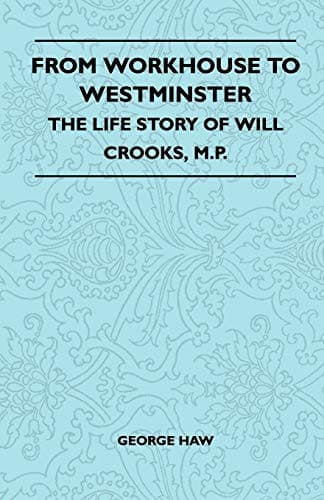
From Workhouse to Westminster: The Life Story of Will Crooks, M.P.Haw, George
History
From Workhouse to Westminster: The Life Story of Will Crooks, M.P.
Haw, George
Crooks, William, 1852-1921; Legislators -- Great Britain -- Biography; Social reformers -- Great Britain -- Biography
One conversation reported to him from a public-house a few days after
the election was certainly quaint and amusing. The narrator was the best
of mimics. He told how the subject of the election was introduced by "a
long thin man with a sheeny nose," who had just come in.
"Well," began the new-comer, without any preliminary, "I've read 'The
Fifteen Decisive Battles of the World,' but I tell you Woolwich licks
the lot."
"What about Napoleon Bonaparty?" ventured one of the company.
"Bonaparty? What did Bony do? Why, ten years after Wellington won
Waterloo things was back worse than they was before."
"I thought Bill Adams won the battle of Waterloo," called out a voice
from the corner bench.
"You shouldn't think; it might hurt yer head."
"D'yer reckon as Crooks is bigger nor Bony was?" inquired the first
questioner.
"Certainly I do," said the long thin one, severely. "What did Bony do?
Why, he made men fight for him. But what did Crooks do? Why, he taught
men to fight for themselves and their families. See? Bony built his
house on the sands, and the tide of humanity has washed it away. Now
Crooks taught us men to build our own house, and nothing can destroy it
while we stick together."
To the new Member there came in due time congratulatory messages from
Europe, America, South Africa, and Australia. Children also sent him
their well-wishes--children are always writing to Crooks--one letter
being signed by a whole family of them in Plumstead with their ages set
out like stepping-stones after each signature. This "little household,"
as they called themselves, told him how eagerly they had "watched the
papers," and how glad they were he had won.
One only of the many letters that poured in sounded a despondent note.
It was signed by two desolate old women who lived together in Poplar.
"We have just heard," they wrote, "you have been elected Member for
Woolwich. Does this mean you are going to leave Poplar? If so, please
give up Parliament, for who have we to look to for help if you go away?"
Some of his supporters were anxious to serve him in a practical way.
The workers at a tailoring establishment in Woolwich asked him to allow
them to make him a suit of clothes "as a thank-offering for the splendid
victory." When a fortnight later they sent the suit it was with an
expression of "regret that it is not like our esteem--warranted not to
wear out."
The Press all over the country was profoundly impressed by the result.
The Liberal papers for the most part were too eager to hail it as a blow
at the Conservative Government to see its true significance. The
Conservative papers, in attempting to lessen its effect on their own
party, got nearer to the real meaning that lay behind the victory.
As the _Times_ put it:--
The result ... means that the questions bound up with the existence
of an organised Labour Party which have been hitherto regarded as
chimerical are coming to the front in practical politics.
Public-domain text, read in full here on John Shaqi.
Reviews
Reviews
No reviews yet
Be the first to share your thoughts on this work.
Elsewhere in the archive
Join the Discussion
Join the discussion
Sign in to leave a comment or review.
Sign InorCreate an account