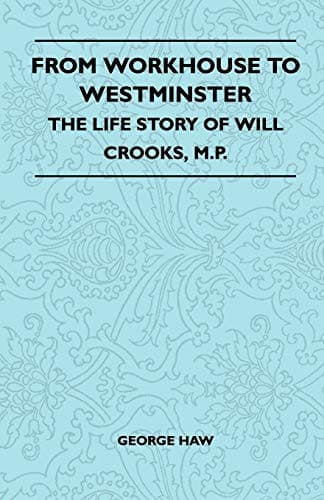
From Workhouse to Westminster: The Life Story of Will Crooks, M.P.Haw, George
History
From Workhouse to Westminster: The Life Story of Will Crooks, M.P.
Haw, George
Crooks, William, 1852-1921; Legislators -- Great Britain -- Biography; Social reformers -- Great Britain -- Biography
Poplar fed its starving poor, and in doing so the Guardians did not
hesitate to raise the rate for the time being by fourpence. In no single
case, however, was money given to families where the out-of-work husband
was under sixty years of age. All they got was a few shillings' worth
of food, just enough to keep body and soul together until the husband
found work again. Had food not been given in this way, scores of
families would have been forced into the workhouse, where the cost of
their keep would have been four or five times greater.
In the following winter, in face of similar distress, the same policy
was followed. It was mainly for thus feeding the starving that the
Poplar Board was afterwards so violently attacked. But, given the like
distress, Crooks stoutly maintains he will apply the same remedy.
"The Poor Law is entrusted to us to prevent starvation," he holds. "My
dead friend and neighbour Dolling used to say that 'the law that
safeguards the poor is always in the hands of those who do not put it
into force.' So long as I live that shall not be said of Poplar."
With all the pressing claims of Poplar and his daily duties in
Parliament, together with the calls made upon his time by the London
County Council and the Asylums Board, he was yet constant in his
attendance at the Guildhall meetings of the Central Unemployed
Committee. He and Lansbury spared themselves in nothing on that
Committee. They believed that on its success depended the future of
State-aid for the unemployed. They believed that such a crisis as they
were grappling with in Poplar in the winter of 1904 would never recur
once they got the State to recognise its duty to assist in organising
useful work for hard times.
"The lesson of all our work on Mr. Long's Unemployed Committee was
this," he told me. "The only way to deal properly with the unemployed in
winter is to make your preparations in summer. The test of the Central
Unemployed Committee will be the character of its organisation in good
times. Only by being well organised when there is little distress will
it prove a success when times are bad. It is far harder to organise
useful work for the unemployed through public bodies than it is to raise
money for their relief."
Crooks himself had seen the dark shadows of that winter creeping up
ominously in the previous summer. Before Parliament adjourned in August
he uttered a warning note in the House of Commons. He asked the Prime
Minister whether the various Government Departments could not do
something to prepare for the exceptional needs. Mr. Balfour's reply was
to the effect that inquiries would be made.
Public-domain text, read in full here on John Shaqi.
Reviews
Reviews
No reviews yet
Be the first to share your thoughts on this work.
Elsewhere in the archive
Join the Discussion
Join the discussion
Sign in to leave a comment or review.
Sign InorCreate an account